Produced water: Asset or liability?
MARK PATTON, President, Hydrozonix, and Contributing Editor, World Oil
BACKGROUND
Produced water has been a hot topic lately, from The Wall Street Journal’s pressure cooker analogy to Bloomberg calling it toxic water. This boogeyman can be the hero of the story. Produced water is a by-product of oil and gas extraction. Today, in the Permian basin, we are talking over 2 MMbbl of produced water every day, and this number is growing.
This isn’t the toxic chemical soup that some want to represent; it really is formation water, trapped water that comes to the surface with oil and gas, as we extract these commodities. In unconventional wells, a completion fluid is used that is mixed with sand and a few chemicals, friction reducers, scale inhibitors and sometimes corrosion inhibitors and biocides. These chemicals are commonly used in water treatment, but this mixture only comes out of the well in the first two to three weeks after that, and for the life of the well we get formation water. So, produced water is primarily formation water, which is extremely high in dissolved minerals and salts. Typically, in the Permian basin, as high as seven times as salty as seawater. And that’s really the problem, it’s too salty.
The most common method for managing produced water is injection/disposal wells permitted as Class 2 wells. Over the years, we have seen when large volumes of produced water are injected into disposal wells, it can induce seismicity or cause earthquakes. Historically, reducing the volumes in these specific seismic zones or areas has reduced earthquakes. The use of hydraulic fracturing, also called unconventional oil extraction, has created a resurgence of oil and gas activity and with it, an increase in produced water.
The reason is that in unconventional drilling, we are drilling mostly horizontally through shale and fracturing it to release the oil and gas, but adjacent formation water is also being extracted. In conventional oil and gas, you drill into a reservoir containing oil and extract the oil, and less formation water is usually present. I am mentioning this distinction, because in conventional oil, as reservoirs empty, you can fill them back with produced water to enhance the oil extraction. This method is called waterflooding or enhanced oil recovery (EOR). EOR becomes another use of produced water from both conventional and unconventional wells, and these are considered Class 2 injection wells. These two methods represent over 90% of how onshore produced water has been managed over the last 10 years.
RECYCLING AS A SOLUTION
With the growth of unconventional drilling and the increase in water demand that comes with it, we have seen produced water being recycled as a completion fluid. The company I work for started doing this in 2012, and I know a few others that started around 2010. Today, recycling accounts for about 30% of the produced water being generated.
If we could use only produced water as a completion fluid, we could get this number up to 50%. But, between logistical concerns like not enough produced water being produced in the areas where the drilling takes place, or you have to move large volumes over long distances, or you have landowners that restrict the movement of produced water or require you to buy their water as opposed to recycling, it will be difficult to get to this 50% number.
Many have looked on recycling as a potential solution to the rising volumes of produced water, but it is more a temporary option and not a permanent solution. You see, drilling and well completions are driven by oil price, and when oil price is down, there are less well completions and you don’t need completion fluids. Then, as an oil field matures, you move drilling and completing to new areas, so the old field has produced water but no drilling and completion work. Meanwhile, the new area has a low inventory of producing wells, so there is not enough produced water. This cycle repeats itself, until there is no more drilling and completions, but there will always be produced water, as long as there is oil and gas being produced. This inconsistency has plagued the recycling business since its inception.
One transition emerging is the Water Midstream, where companies are taking over the disposal wells and associated infrastructure and more recently building large-scale recycling centers. This has helped to increase recycling, as these facilities can aggregate large volumes of water, making more water available. This makes recycling a good practice but not a reliable and permanent solution.
Because of criticism over water consumption, most major oil companies have eliminated the use of fresh water and replaced it with produced water for their completion fluid and used brackish water to supplement when there isn’t enough produced water as a result of logistical concerns I mentioned earlier. It is typical for major operators to report they are no longer using fresh water and, instead, using produced water and brackish water for their well completions. One super major reported that 70% of its completion fluid is produced water, with brackish water making up the remaining 30%.
THE EARTHQUAKE PROBLEM
As previously mentioned, in areas where there is a high density of disposal wells and large volumes of water injected, we have experienced, induced seismicity. The prevailing theory is this injection from disposal wells is the cause. The solution that has worked in other areas is reduce the volume, or move the injection away from the seismically active areas, and this solution has worked.
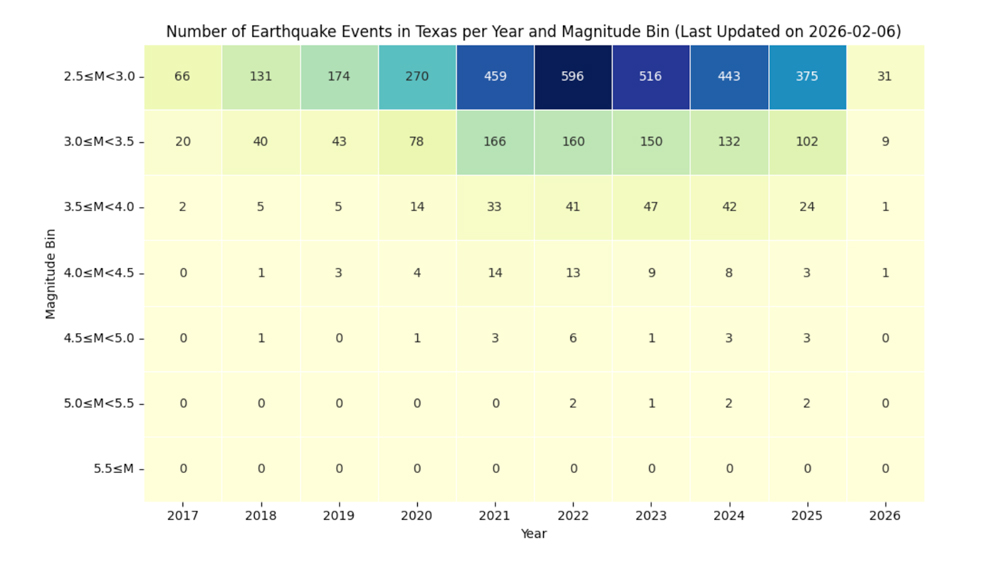
In the Permian basin, when we started to see earthquake activity increase, the Texas Legislature in 2015 began the process of forming Texnet, which began monitoring earthquakes and collecting data in 2017. These earthquakes peaked in 2022 and have been on the decline ever since, Fig. 1. In 2021 the Railroad Commission of Texas (RRC) started the process of defining Areas of Review (AORs) and then within these AORs forming Seismic Response Areas (SRAs). These SRAs defined areas of concern and began limiting disposal activity in these areas.
In 2022, Operator Response Plans were required, where the companies in these zones were required to take action. These operators led groups focused on depth of the disposal zone and expanding data collection. In the Permian, deeper disposal zones were identified as the primary cause, and in one of the SRAs referred to as the Culberson Reeves SRA, deep injection volumes were curtailed, leading to no deep disposal in 2024. As a result, there was a transition from deeper disposal to more shallow disposal.
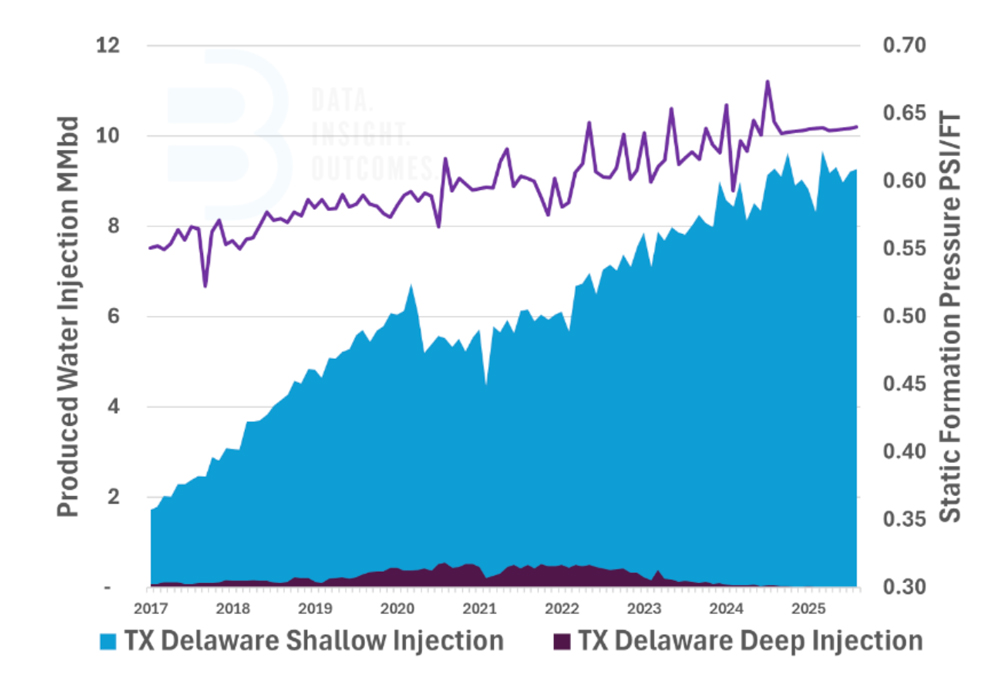
Figure 2 is courtesy of B3 Insights, a firm that provides great data on all things associated with produced water. The B3 Insights graph shows that deeper disposal was much lower in comparison to the shallow disposal. But as the volume increased in deeper disposal, it coincided with more and larger earthquakes. As this deeper disposal was reduced or eliminated, the Texnet graphic shows there has been a steady decline in earthquake activity from these actions and because of the RRC and operator responses.
THE PRESSURE PROBLEM
Another concern is the increasing pressure in these disposal formations. Even with the curtailing of deeper disposal and the reduction in earthquake events, we are seeing increasing pressure continue. Concerns over climbing pressure have resulted in industry looking for alternatives to disposal, with the biggest focus being on desalination of produced water for either beneficial reuse or discharge.
One area specifically is the Delaware Mountain Group in the Delaware basin of the Permian basin. We are seeing increasing pressure climb, and we know overall produced water volumes will also continue to rise. The B3 Insights graphic (Fig. 2) also shows this increasing pressure. One of the concerns associated with rising pressure is blowouts, especially in orphan wells.
Orphan wells are abandoned wells that result in the company that drilled them going out of business and abandoning them. Part of the permitting process requires bonding, and the RRC takes these proceeds and then supplements them. The RRC in 2025 budgeted $100 million on this program. In 2025, they plugged 1,100 wells and have plugged 46,000 since its inception. The RRC has 50 rigs working exclusively on plugging wells.
Of these wells, over 95% are not leaking at all. But the perception is that we have an out-of-control program, with produced water geysers sprouting up everywhere, which is a bit of an exaggeration. A subset of these wells is unknown wells or what people have called zombie wells. These are wells that were never identified and never permitted, but which people encounter from time to time. Again, the perception is that there are zombie wells everywhere. In fact, our company responded to one of these wells and, within the same day, the water flow was stopped. According to the RRC, a busy year for them is discovering 10 of these wells.
The RRC has taken this a step further by forming a new Subsurface Investigation group, which is looking at causation, not just plugging. The RRC has also implemented a new Disposal Well Review program. Under this program, the AOR we mentioned earlier is expanded. The AOR expansion has gone from ¼-mile to a ½-mile and 2 mi.
Under the new requirements, the applicant has to assess old and unplugged wells. In the ½-mile review, casing and cementing information is required, and competent cementing is required in all wells within the ½-mile interval. All inactive wells will require annular cement and wellbore plugs. The goal here is to prevent fluids from migrating.
Within the 2-mi radius, the AOR will focus on unknown or orphan wells. If they are encountered, then there will be a deduction in the applicants’ injection pressure. This puts the pressure on the applicant to address and/or plug these wells, to avoid the pressure reduction requirements. So, the idea that the industry and regulators have a runaway “pressure cooker” problem is an exaggeration. What we are seeing is an active response that shows results.
OUT-OF-BASIN DISPOSAL
One of the additional trends we are seeing is primarily from the Water Midstream sector, and that is out-of-basin disposal, where they build the pipeline and associated infrastructure to move produced water away from these active regions. Here, we are seeing interest in the Central basin. In 2019, NGL was the first midstream operator to implement an out-of-basin disposal program through their LEX Pipeline system, which sends produced water to their facilities in Andrews County. As this practice grows, we will see operators moving produced water away from high-pressure or seismically active areas to help mitigate these concerns.
THE CARBON-WATER NEXUS
I mention EOR as one of the methods used to manage produced water. We are seeing an expansion of this process, especially with the addition of carbon dioxide (CO2). Adding CO2 to waterfloods/EOR improves the oil recovery, but it also provides for sequestration of carbon. We are seeing carbon capture, utilization and sequestration (CCUS) emerge as its own industry. In the U.S., this is partly a result of the 45Q program, a tax credit for CCUS. This program’s tax credit was steadily increased under the Obama and Biden administrations and recently under the Trump administration.
Combining the 45Q tax credit with the voluntary carbon market helps offset the cost of CCUS and has been the primary driver, as the carbon market is expected to increase in value. Currently, the biggest participation in the 45Q program comes from EOR. So, as EOR expands as a produced water management option, we have increased opportunity to offset carbon. Combine that with the biggest investments in CCUS, which have come from major oil companies. Oxy is building one of the largest Direct Air Carbon Capture plants in the Permian basin.
We are also seeing the development of Class 6 Carbon Sequestration wells and Class 2 Acid Gas Injection (AGI) wells being used for Carbon Sequestration. The company I work for has patented a technique that allows for Carbon Sequestration on existing disposal wells. We are also seeing a research and development effort to use EOR on unconventional wells again, finding a new use for produced water and CO2. This turns produced water into a valuable asset for carbon sequestration. Combine that with carbon sources in the Permian basin like gas processing facilities, compressor stations and power generation and, coming soon, data centers. The oil and gas industry is moving towards carbon zero partly by using produced water.
CRITICAL MINERAL RECOVERY
One new area of interest around produced water has been that of critical mineral recovery. Produced water, by nature, is saturated with many minerals some of those are critical minerals, but in general the critical minerals have been in lower concentrations.
Nonetheless, there are many companies looking at critical mineral recovery from produced water. One of these companies, LibertyStream Infrastructure Partners, through a recent agreement with Select Water Solutions, is building out commercial facilities at certain Select locations. Their first facility was in Reeves County, but it had limited capacity of about 10 tons per year. There are many others considering this approach, and anything that offsets the cost of managing produced water is progress. Although exciting, I don’t see this as a growing trend.
One of the issues is that some produced water has very low concentrations of lithium and also has many other competing minerals, making the extraction harder. This can affect the purity of the lithium. There are some major oil companies getting into the lithium recovery business, but they aren’t pursuing produced water. They are looking at other brines that don’t have the other saturated minerals and have higher lithium concentrations. Where it makes sense, we should expect to see more mineral recovery take place.
DESALINATION ISN’T NEW, BUT IT IS THE FUTURE
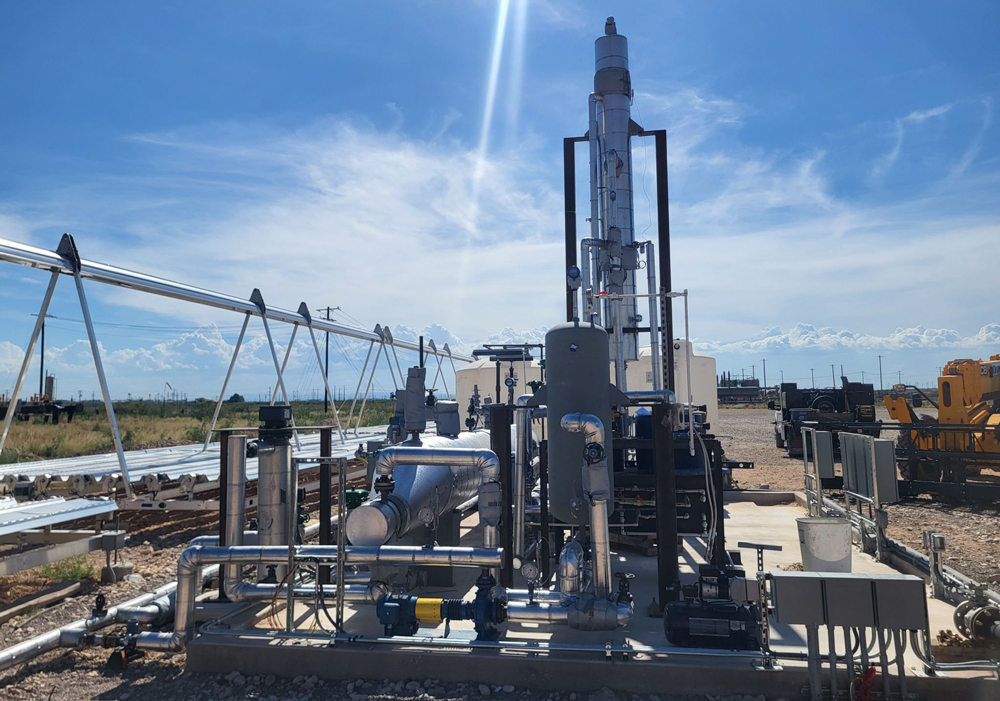
One of the areas getting the most attention is desalination, to allow for beneficial reuse and discharge of produced water, Fig. 3. Although this seems straightforward, the problem is that Permian basin produced water is extremely salty, and most desalination technologies are designed for ocean water. As a result, produced water in the Permian basin needs a more innovative approach.
Adding to the complexity, there has always been some regulatory uncertainty, and ownership of produced water has also lacked clarity. So, we are talking about legal, regulatory and technical hurdles. Even states like California, which is very anti-oil, allow for treatment and discharge of produced water. However, California produced water is far less salty and closer to seawater, even lower in salinity at times.
Treating produced water for discharge is not new, and there are a few decades of historical discharges. Back in 2011, the federal government established the Produced Water Treatment and Beneficial Use Information Center, targeting at the time water produced from coalbed methane. In 2009, NGL commissioned their Anticline desalination facility in Pinedale, Wyo. This facility has discharged more than 60 MMbbl of treated produced water into the Upper Green River basin.
WHAT’S STOPPING DESALINATION
There have been many obstacles, for one the 98th Meridian, often referred to as the demarcation of where the Great Plains begin in a book written in the 1930s. But there also are references back to the late 1800s. This line travels right through Texas, and west of this line produced water discharges are prohibited, and east of this line they are allowed but under a permit issued by the Texas Commission on Environmental Quality (TCEQ). Before that, it was prohibited.
Then there is the famous Cactus Water Services vs COG Operating case that was recently ruled on in the Texas Supreme Court this past summer. The basis of this case was who owns the produced water—the surface owner or the mineral rights owner. The case went the way it should and went the mineral rights owner. But this case is indicative of the evolution of produced water from liability to asset.
Who would have imagined that someone would fight for the right to own wastewater that most people saw no value in, but as industry matured, suddenly people saw a future where produced water could have value, and we are closer to that today.
In 2019, in New Mexico, they passed the Produced Water Act, which among many things clearly defined who owns the produced water. As you can imagine, would you invest in cleaning water that someone else could claim as theirs? These actions paved the way for more investment into produced water. Even more recently in Texas, new laws were passed to limit tort liability, under H.B. 49 individuals and entities involved in the treatment, storage or transfer of produced water are not liable in tort for any consequences stemming from their use of the treated produced water. And finally, the TCEQ is developing discharge standards for produced water as directed by the legislature. That path is becoming clear.
THE FUTURE IS NEAR, BUT HOW DID IT START
Currently there are five permits under review; the first is a discharge permit for NGL. At the publishing of this article, this permit will likely be out for public review. There they go again, NGL leading the way. But this progress didn’t come overnight. So let me rewind a few years.
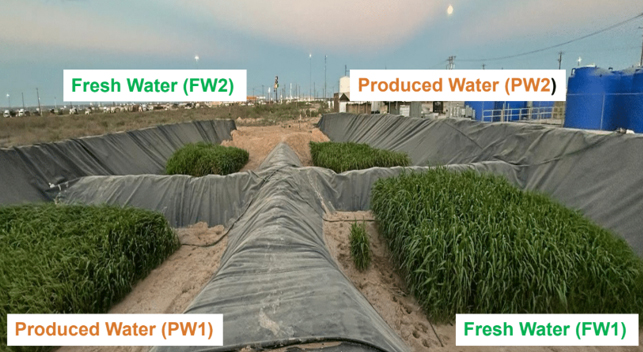
In New Mexico, the New Mexico Produced Water Research Consortium (NMPWRC) was formed, when the New Mexico Environmental Department (NMED) entered a Memorandum of Understanding with New Mexico State University (NMSU) in September 2019. This paved the way for a collaboration between industry, regulators and academia.
Through the NMPWRC, research was conducted on what made up produced water, how do we treat it, what technologies are available or are developing for treatment, and how do we support legislation. All this led to a groundbreaking announcement at the United Nations Climate Change Conference (COP28) in Dubai by the New Mexico governor that New Mexico would set aside money for beneficial reuse of produced water (Fig. 4), only to come home to opposition.
Even when the political hurdle seemed to be overcome, the opposition secured their victory, and the anti-oil lobby was able to stop progress and prevent a solution for drought and earthquakes from materializing. In my opinion, this anti-oil lobby needs to have a platform to raise money and stopping progress is part of their platform. Luckily, the Texas Produced Water Research Consortium was formed in 2021 and then funded in 2023 and was able to pick up from the progress of the NMPWRC. With a more politically supportive environment, Texas created funding for more produced water research and created legislation to pave the way for beneficial reuse.
FROM LIABILITY TO ASSET
What we are seeing is a transformation. Produced water will likely be beneficially reused in 2026 in the Permian basin at an increased scale. There are companies from around the world converging on the Permian basin to provide desalination technologies. This innovation and competition with scale will lead to a dropping cost.
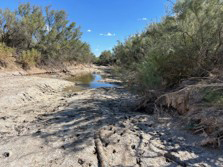
Over the next 10 years (could be five years if not for the opposition), we expect beneficial reuse to outpace recycling. With the emergence of Data Centers and drought conditions (Fig. 5) in West Texas, the demand for new water will be increasing, and treated produced water will be there to fill that demand. I see a future where the oil industry can be a carbon zero low-cost provider of energy while being a net producer of water, and that is the sustainability story of the century. Anti-oil lobbyists may slow progress, but they won’t stop it. And fortunately for us, we will witness this transformation in our lifetime.
MARK PATTON is President of Hydrozonix and a Contributing Editor to World Oil. He has several decades’ experience in the development, design, implementation and operation of treatment technologies, both nationally and internationally. He also holds several produced water patents. Mr. Patton earned his BS degree in chemical engineering from the University of Southern California.
Related Articles- Precision in flare measurement paves the way for a sustainable future in the oil and gas industry (March)
- Integrating real-time drilling analytics to reduce carbon intensity and operational risk (March)
- Produced water treatment market: The next big wave in industrial sustainability (March)
- Water management: New disposal well requirements (January)
- Management issues: Ten years after the Paris Climate Agreement, Climatism is crumbling (December 2025)
- Executive viewpoint: Investing in existing oil & gas fields is key to energy security and net-zero goals (November 2025)
- Subsea technology- Corrosion monitoring: From failure to success (February 2024)
- Applying ultra-deep LWD resistivity technology successfully in a SAGD operation (May 2019)
- Adoption of wireless intelligent completions advances (May 2019)
- Majors double down as takeaway crunch eases (April 2019)
- What’s new in well logging and formation evaluation (April 2019)
- Qualification of a 20,000-psi subsea BOP: A collaborative approach (February 2019)