First Oil: Our Deepwater Development Conference rides the sector’s momentum
KURT S. ABRAHAM, EDITOR-IN-CHIEF & CHIEF FORECASTER
One can scarcely blame you, our readers, if you’re beginning to fatigue from the current news cycle. Between the Middle Eastern mess, the depressed U.S. shale sector and continued policy shortcomings in a couple of regions, there hasn’t been all that much to be positive about.
But if you’re looking for some consistently good news, look no farther than the deepwater sector of the industry. While other areas stagnate, this sector is quietly booming. This fact was borne out very recently at our company’s annual Deepwater Development Conference (DD). Held during March 10-12 in Lisbon, Portugal, DD is one of the industry’s premier specialty conferences, hosted by World Oil, parent Gulf Energy Information and sister publication Petroleum Economist. As such, we had 200 senior deepwater executives, managers and specialists in attendance, who heard a very encouraging collection of technical and market analysis presentations, as well as panel discussions.
Our attendees represented a wide swath of deepwater operators, including (in no particular order) TotalEnergies, Petrobras, Eni, Chevron, Woodside Energy, Repsol and Petronas. The equipment/service attendees were an even wider collection. Among the companies represented were SLB OneSubsea, McDermott, MODEC, NOV, SBM Offshore, BW Offshore, Hunting, ABS, Aizo, Elementz, Sonardyne, TDI Brooks, TechnipFMC, Siemens Energy, Subsea 7, Baker Hughes, Oceaneering and Welligence.
There are good reasons why deepwater specialists were in abundance at DD, as World Oil’s own data from our February forecast indicate that activity is on a significant upward trend. For instance, in a sample group of six countries with significant deepwater drilling—Brazil, the U.S., Guyana, Nigeria, Angola and Namibia—the number of deepwater wells expected this year is expected to rise 20.5%. Compare this rate to the 4.8% increase predicted for all offshore drilling worldwide.
Then, one should look at the rise in deepwater production rates. In our sample group of deepwater-oriented countries that have established oil production (minus Namibia), output of deepwater fields rose 11.2% in 2025, compared to 2024’s level. This compares to the total global oil production rate that gained 2.3%. Clearly, the deepwater segment of the upstream industry has the wind at its back.
What follows is a collection of highlights from the two-and-a-half days of DD sessions.
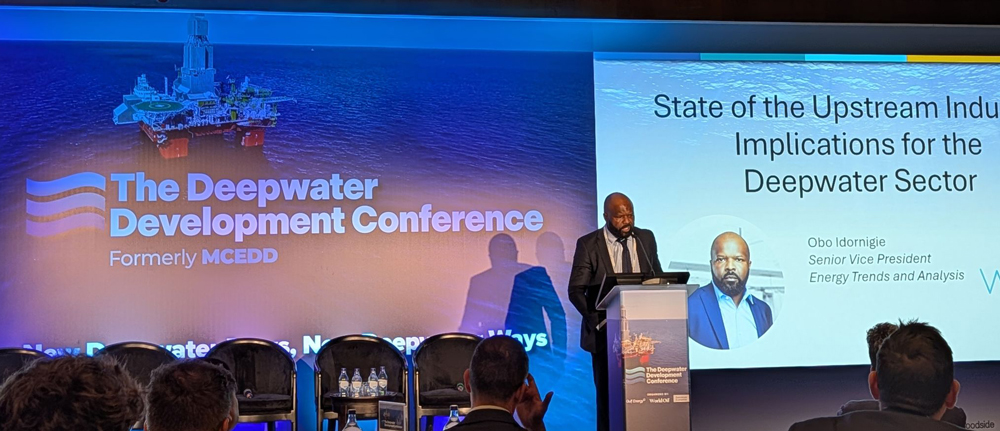
Day 1 highlights. The DD conference got off to a roaring start on March 11, featuring an operator’s panel, two solo speakers, and a case studies/lessons learned session in an afternoon-only agenda. Leading off the afternoon sessions was Obo Idornigie, Senior V.P., Energy Trends & Analysis, at Welligence, Fig. 1. Looking at the global market overall, he noted that investment should remain flat for the third year running. However, he added, “despite near-term wobbles, long-term demand remains robust.” Idornigie also stated that there is recognition that exploration needs to be stepped up by the major operators.
Meanwhile, he declared that “deep water” is a core growth engine, and Brazil and Guyana will continue to underpin deepwater production growth.” Idornigie said that since 2020, roughly $200 billion has gone to deepwater projects, yet only three key deepwater projects progressed during 2025.
On the positive side of the ledger, said Idornigie, the deepwater emissions footprint continues to improve, including on FPSOs. He also noted that there is a $20 billion contract backlog among the top deepwater drilling contractors.
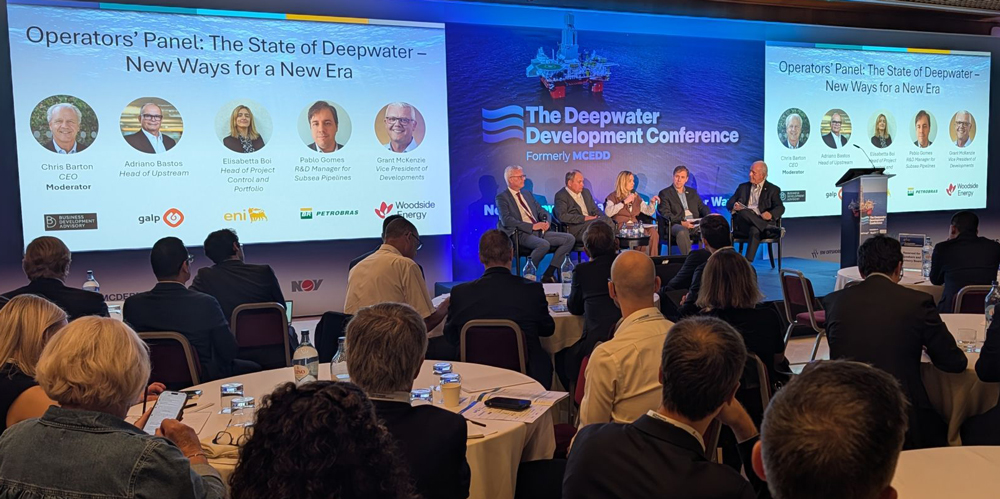
Meanwhile, operators are under increasing pressure to deliver projects faster and with greater capital discipline. That message was reinforced during the Operators’ Panel, where industry leaders outlined how collaboration, digitalization and standardized development models are reshaping offshore project execution, Fig. 2.
The panel featured Adriano Bastos, head of upstream at Galp; Elisabetta Boi, head of project control and portfolio at Eni; Pablo Gomes, R&D manager for subsea pipelines at Petrobras; and Grant McKenzie, vice president of developments at Woodside. The discussion focused on the role deepwater will play in the coming decades and how operators are adapting development strategies to manage complexity, cost and execution risk.
Panelists broadly agreed that deepwater remains one of the most attractive sources of long-term oil supply, exemplified by large discoveries in regions such as Brazil. However, speakers emphasized that deepwater projects remain among the most complex upstream developments. A central theme was the importance of engaging partners earlier in the development cycle. Digitalization is also playing a growing role in offshore project management.
Day 2 superlatives. The DD conference continued in high gear on March 11, featuring a Contractors’ Panel, two solo speakers, and three themed technical sessions.
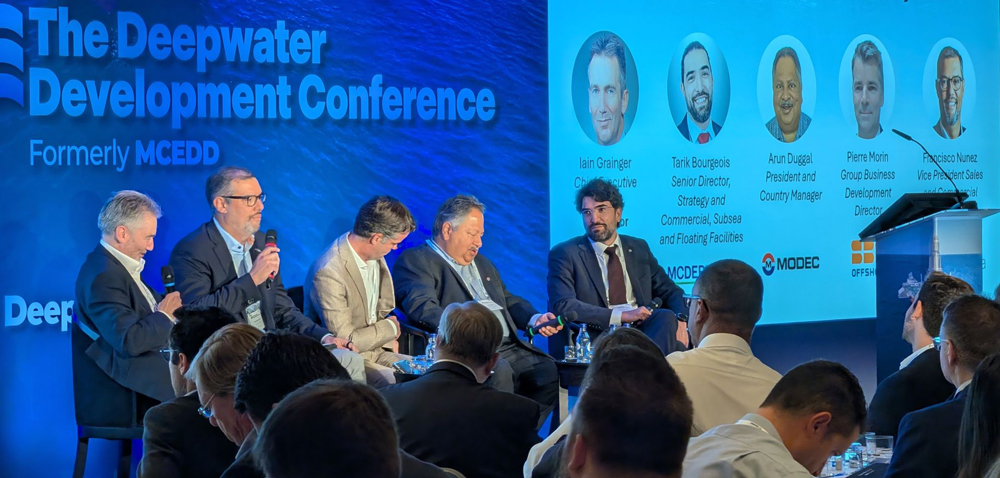
In the Contractors’ Panel, participants said the industry is entering a new phase of offshore development, one defined by strong project opportunities but also by tighter execution requirements and increasing supply chain pressure. Panelists (Fig. 3) discussed how early engagement, standardization and collaboration will be essential to delivering the next wave of offshore projects.
The session featured Tarik Bourgeois, senior director, Strategy and Commercial, Subsea and Floating Facilities, McDermott; Arun Duggal, president and country manager, MODEC; Pierre Morin, group business development director, SBM Offshore; and Francisco Nunez, vice president, sales and commercial, SLB OneSubsea.
Panelists said the offshore market continues to present a wide range of opportunities, from brownfield life extension work to new developments in emerging offshore provinces. However, panelists emphasized that the success of projects increasingly depends on how effectively the industry organizes itself to deliver them. Early engagement with the supply chain was repeatedly highlighted as an effective tool for improving project outcomes.
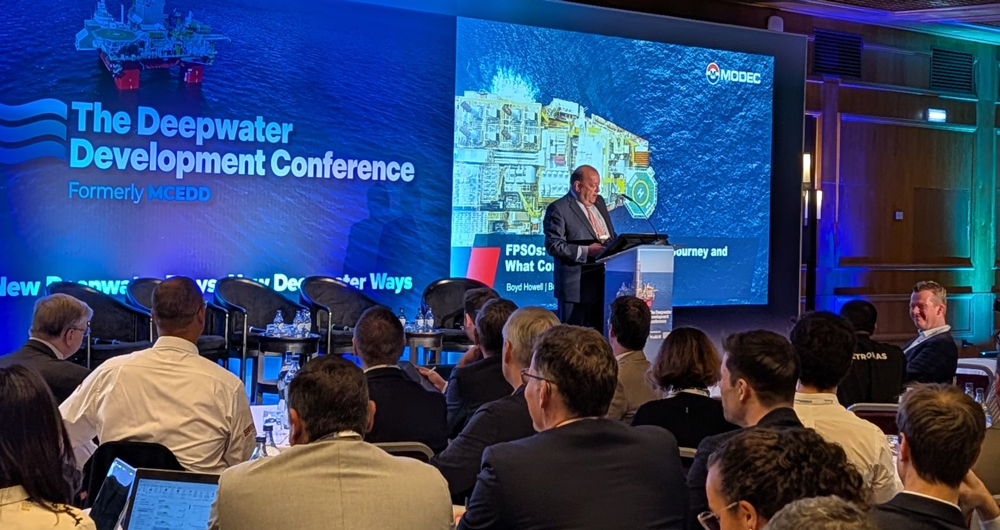
Earlier in the day, MODEC Director of Sales & Marketing, Boyd Howell (Fig. 4), delivered an informative keynote address on the 40-year development of FPSOs and where that process might be headed in the future. Howell noted that “Brazil is one of the best examples of deepwater offshore [evolution], and we operate 13 vessels there.”
Howell said that digitalization of FPSOs has been spread out over three distinct time periods. In the first phase, up to 2000, automation was the primary concern. Then, in the second phase, between 2000 and 2015, connectivity and data accumulation were the priorities. In the ongoing third phase since 2015, intelligence has been the primary task. The industry can expect that offshore facilities, including FPSOs, will be increasingly automated, predicted Howell.
Day 3 insights. The final day of DD featured a keynote address, one panel, and three themed technical sessions.
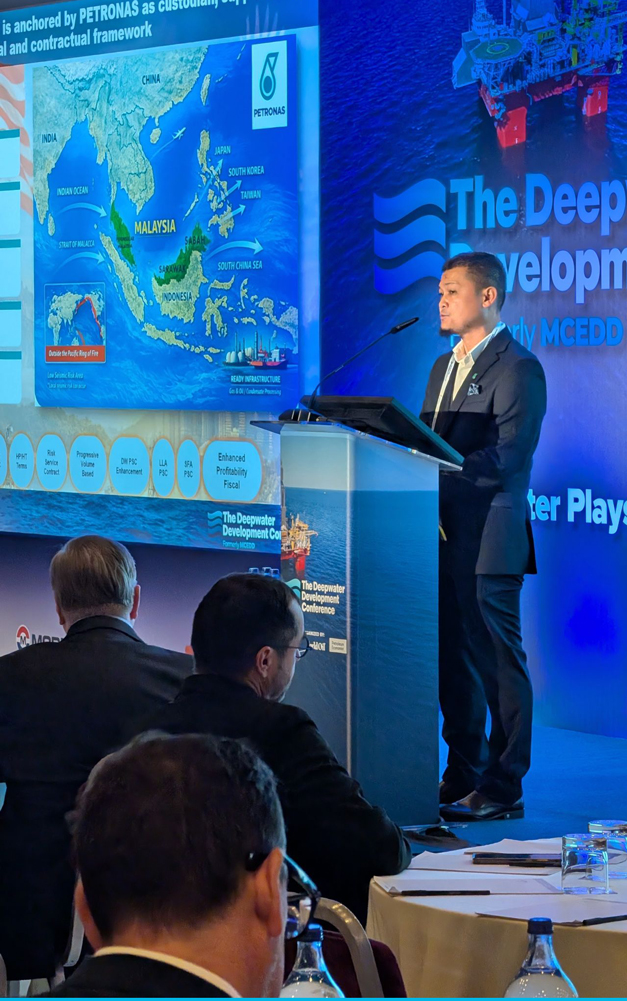
The highlight of the day was a keynote address by Budi M. Nasron (Fig. 5), General Manager, Resource Development & Management-Sabah, Malaysia Petroleum Management, at state firm Petronas. Nasron noted that while larger deepwater producers, such as Brazil and Guyana, get most of the attention, Malaysia certainly has its share of such output.
“Deepwater wells are contributing up to 30% of Malaysia’s total oil production,” said Nasron. He explained that the country produces 1.8 MMboed, with about 75% of that being natural gas. The remaining 400,000 boed or so is oil. A majority of Malaysian production occurs in Sarawak state.
“The first Malaysian deepwater discovery was in 1994,” said Nasron, and there has been a steady string of finds since then. “The Megah oil discovery in 2025 is the most recent one,” he added. Situated offshore Sabah state, its initial reserves are estimated at 200 MMboe to 300 MMboe, and Petronas is beginning early development work to move the field forward.
Meanwhile, Nasron said Petronas is running extensive seismic surveys to identify additional oil and gas prospects that could be awarded for exploration. Among the more notable deepwater fields developed off Malaysia is Kikeh, which is operated by PTTEP and went onstream in 2007. “Kikeh was the first-ever truss spar platform installed outside the Gulf of Mexico/America,” said Nasron.
Another highlight of the conference’s final day was the last session, an Operators’ Panel, Fig. 6. Participants included Jean-François Stachera, Performance & Engagement Manager for TotalEnergies’ GranMorgu Project; Christie Brown, Director for Offshore Business Asset Development at Chevron; and Petronas’ Budi Nasron.
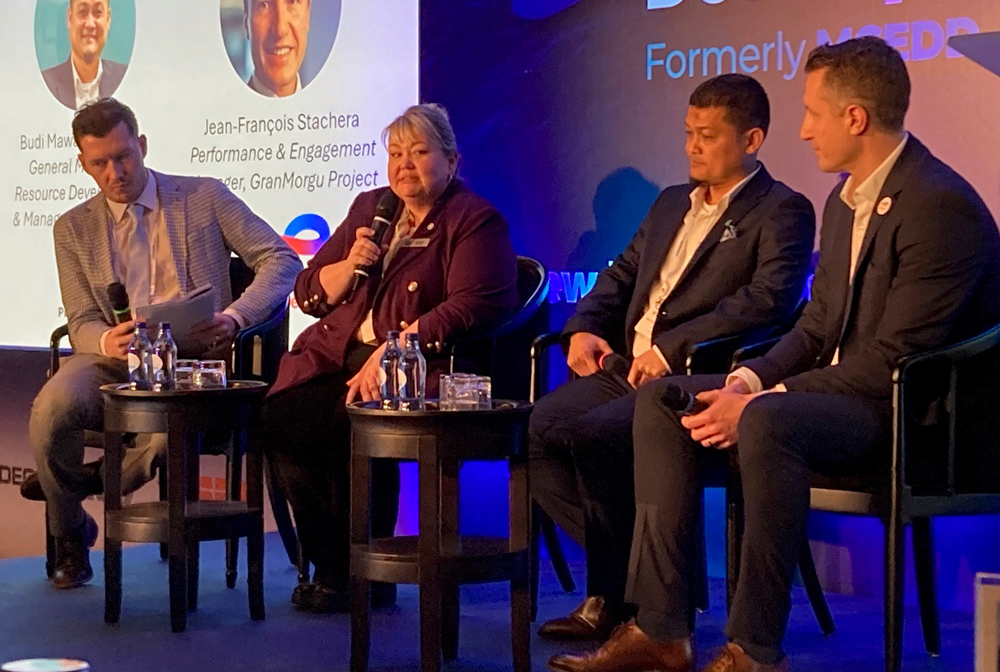
The panelists tackled a number of issues, including whether new technologies are helping to de-risk exploration and appraisal. The collective answer was “yes,” albeit with caveats that one can never be totally sure about a prospect until a well is drilled. There also was enthusiasm for the thought that successful, thoughtful project execution, accompanied by good collaboration between operators and their service partners, can reduce project over-runs.
Next year’s edition. At the end of Day 2, Gulf Energy Information President & CEO John Royall announced that TotalEnergies has agreed to host Deepwater Development Conference 2027. The conference site will be in Bordeaux, France. For those of you with a work role or significant interest in deepwater operations, we certainly encourage you to consider next year’s event. In the next few months, we will pass on details about the conference venue, program and registration, as they become available.
IN THIS ISSUE
Special focus: Sustainability. Among our four features, our Contributing Editor, Mark Patton, delves into whether produced water is an asset or liability in the Permian basin. A second article discusses how start-up firm Hephae Energy Technology has broken the 200oC temperature barrier in directional drilling, a challenge pursued for 25 years by industry giants. In the third feature, a Fluenta expert describes the tightening of methane and flaring regulations and the need for precise measurement. Finally, the fourth article from Research Nester explores how the produced water treatment market is the next big wave in industrial sustainability.
Drilling technology. Two articles tackle very different aspects of drilling technology: bits and real-time analytics. In the first feature, Associate Editor Olivia Kabell examines and details the most recent drill bit advancements over the last 12 to 18 months, by company and type. Discussion focuses on PDC bits, hybrid bits, digital integration innovations and geothermal drilling advancements. In the second article from B-GEO, experts discuss how a hybrid real-time framework—combining physics-based subsurface modeling with high-frequency anomaly detection—reduces decision latency, limits escalation into high-energy remediation and improves repeatability across wells and disposal networks.
Regional report: Brazil. Contributing Editor Gordon Feller says that Brazil is reaching for new heights in 2026. From record-shattering pre-salt output, and a landmark OPEC+ debut, to a $109 billion investment mandate and the contradictions of hosting COP30, Brazil’s hydrocarbons sector has entered one its most consequential chapters.
Related Articles- Deepwater’s playbook for delivering growth (April)
- Unlocking ultra-high-pressure reserves: Why Shenandoah is a milestone for deepwater engineering and advanced chemistry (March)
- FPSOs, reliability and gas turbine air intake filtration (February)
- Engineering for the deep: Human support and rescue systems (November 2025)
- Full-scale test rig validates benefits of electric BOP (August 2025)
- Powering Mero-3: A look inside one of the world’s largest deepwater FPSOs (August 2025)
- Subsea technology- Corrosion monitoring: From failure to success (February 2024)
- Applying ultra-deep LWD resistivity technology successfully in a SAGD operation (May 2019)
- Adoption of wireless intelligent completions advances (May 2019)
- Majors double down as takeaway crunch eases (April 2019)
- What’s new in well logging and formation evaluation (April 2019)
- Qualification of a 20,000-psi subsea BOP: A collaborative approach (February 2019)