Multiphase surface pump boosts revenue for Pemex while reducing costs and environmental impact
LUIS NUOVA and JUAN ORLANDO RIVERA, SLB
OBJECTIVE
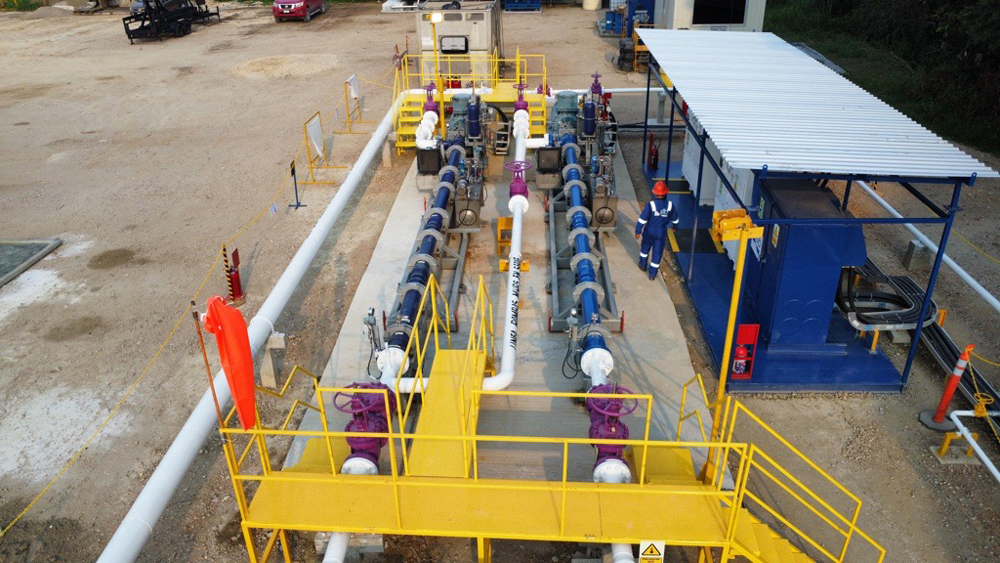
Pemex was facing significant challenges in the 5P field, in southeastern Mexico, Fig. 1. Oil produced from a six-well pad was transported daily to a central processing facility by an extensive fleet of trucks—a time-consuming and expensive operation. Moreover, 3 MMcfd of produced gas had to be flared prior to transporting the oil, resulting both in the release of CO2 emissions and the loss of valuable hydrocarbon resources. Subsequently, Pemex was seeking a comprehensive solution to eliminate flaring and streamline operations.
RESULTS
SLB implemented a tailored solution, based on its Reda Multiphase HPS pump—controlled by a variable speed drive (VSD)—and third-party gas-powered generators. Two pumps were supplied: one for immediate use and a second for future wells. The results were transformative; Pemex not only achieved its environmental goals, but it also enhanced operational efficiency and profitability. Among these benefits were the following:
- The ability to pump multiphase fluids through pipelines to the processing facility has removed the need for separators, storage tanks, trucks, and flaring; it has also simplified logistics.
- Associated gas is now monetized at the processing facility, boosting revenue.
- The pump enables a more aggressive drawdown, resulting in increased oil production.
- The new generators have eliminated dependence on the power grid. Moreover, they are fueled by gas from one of the wells—a cleaner and more cost-effective energy source than diesel.
Pemex is also benefiting from significant savings in transportation services. Previously, the trucks traveled an average of 95,400 km/month and consumed 35 L of diesel per 100 km. By eliminating these trips, the new solution is providing monthly savings in excess of $47,000.1
Additional benefits include lower HSE risk, reduced traffic congestion and decreased wear-and-tear on public infrastructure. The success of this project sets a precedent for future applications of Reda Multiphase HPS pumps in similar fields.
According to a Pemex 5P Asset Manager, Southern Region:
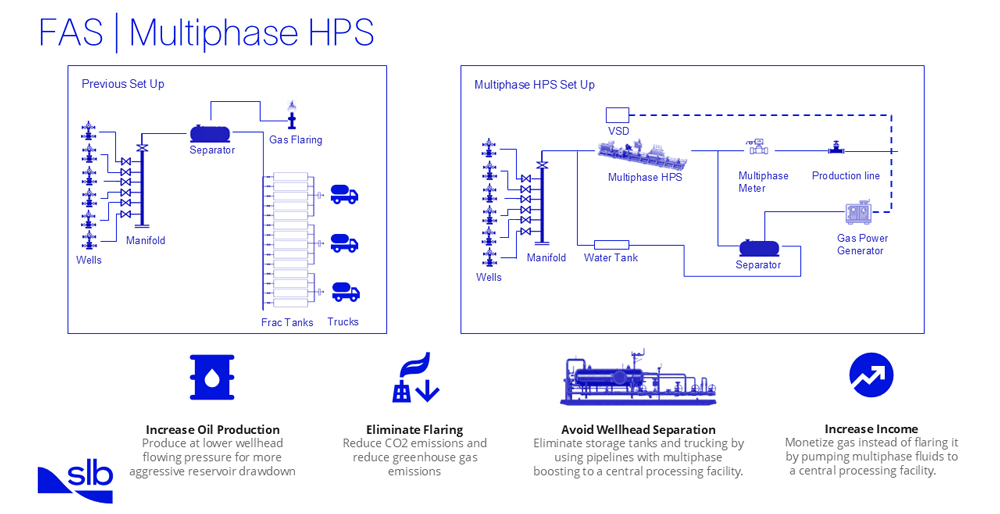
"The solution provided by SLB has been a game-changer for our operations in the 5P field. By eliminating gas flaring, we’ve reduced our CO2e emissions while monetizing what was previously a wasted resource. The implementation of gas-powered generators has given us energy independence, and eliminating the need for daily truck trips has not only cut costs but also improved safety and reduced our environmental footprint. This project is a clear example of how innovative technology can solve complex challenges and deliver transformative results,” Fig. 2.
AUTHOR’S NOTE
- Based on an average diesel cost of $1.41/L.
LUIS GUSTAVO NUOVA serves as the product champion for Horizontal Pumping Systems at SLB in Houston, Texas. He holds a bachelor’s degree in computer engineering from the Universidad Nacional de Tucumán in Argentina. With 18 years at SLB, he has gained notable experience, including leading projects in Mexico and Argentina, enhancing well performance, and securing major contracts.
JUAN ORLANDO RIVERA is an Artificial Lift Systems Sales Engineer at SLB, based in Villahermosa, Mexico. With 29 years of experience in the oil and gas industry, he specializes in application software and production engineering. Juan plays a significant role in managing mechanical pumping contracts for PEMEX's South Region. His career highlights include working as a Production Engineer at SLB since 2013, and previously as a Technical Specialist at PEMEX. He is proficient in nodal analysis, subsurface simulation, and various computer programs such as PIPESIM and AutoGraph PC. Juan is passionate about artificial lift systems and reservoir engineering.
Related Articles- Drilling technology: Optimizing high-pressure pump performance with fluid end advances (May)
- Regional Report: Gulf Of America/Mexico (April)
- Precision in flare measurement paves the way for a sustainable future in the oil and gas industry (March)
- Integrating real-time drilling analytics to reduce carbon intensity and operational risk (March)
- Produced water: Asset or liability? (March)
- Produced water treatment market: The next big wave in industrial sustainability (March)
- Subsea technology- Corrosion monitoring: From failure to success (February 2024)
- Applying ultra-deep LWD resistivity technology successfully in a SAGD operation (May 2019)
- Adoption of wireless intelligent completions advances (May 2019)
- Majors double down as takeaway crunch eases (April 2019)
- What’s new in well logging and formation evaluation (April 2019)
- Qualification of a 20,000-psi subsea BOP: A collaborative approach (February 2019)