Faster well design is reshaping rod lift optimization
PETER WESTERKAMP, Lufkin Industries
Artificial lift solutions are evolving to greater leverage digitalization advances that maximize engineers' time and optimize well designs. Advances in digitalization are driving the evolution of artificial rod lift design solutions, helping engineers work more efficiently and achieve better well designs.
For operators managing both mature and new wells, rod lift optimization requires generating multiple well design scenarios and quickly converging on the most efficient and reliable solution, to make the correct operational decision.
Every rod-lifted well has its own combination of production targets, pump depth, required rod string configuration, stroke length, speed, motor size, torque limits, counterbalance requirements, energy consumption and failure thresholds. Change one variable, and the rest of the system may need to be re-evaluated. That has always been part of artificial lift design, but the pressure to get it right has increased as operators look to extend the economic life of existing assets while controlling costs, and do so with fewer people, often with less experience.
MATURE WELLS LEAVE LESS ROOM FOR DESIGN ERROR
The U.S. well base underscores why that matters. The Energy Information Administration reported that the United States had 918,481 producing oil and gas wells in 2024, and that wells producing 15 boed or less accounted for 78% of U.S. wells in both 2023 and 2024. In other words, many wells are not high-volume producers, but they still represent a significant operational workload.
For low-rate or stripper wells, the economics can be especially unforgiving. The goal is often straightforward: keep the well producing as long as possible, avoid unnecessary rod or tubing failures, reduce the need for workovers and run the system as cost-effectively as possible. On these wells, a design decision that looks uncomplicated on paper can have real consequences in the field. An overloaded component, an underbalanced pumping unit or an oversized motor can add cost, increase stress on equipment or shorten run life. A further consideration is that downhole mechanical failures in low producers can trigger a plug-and-abandon decision rather than a repair, permanently removing the well from production.
At the same time, leaner technical teams are managing more wells, while experienced engineers and the deep field knowledge (tribal knowledge) that they carry continue to retire or move on. Capable as they are, newer engineers are starting without that foundation.
That is where modern rod lift design tools are beginning to change the workflow. The value is not simply that engineers can run a calculation faster. The larger benefit is that they can test a wider range of operating conditions, compare outcomes more clearly and quickly, and narrow in on a design that fits the economics and physical limits of the well.
SCENARIO MODELING HELPS ENGINEERS TEST MORE POSSIBILITIES
Historically, scenario analysis could be a slow, manual process. If an engineer wanted to test different assumptions, he or she often had to copy a design file, change the parameters, save it as a new file, run the case and repeat the process again for the next variable. Comparing results could mean opening multiple reports side by side and manually looking for the meaningful differences.
That approach limits how many scenarios an engineer can realistically evaluate. When every design iteration takes additional setup time, teams may only have time to test a small number of options. But mature wells rarely behave according to a single clean assumption. As production declines, pump diameter or depth changes over time, operating speeds are adjusted, and equipment ages. A design that works well with one set of conditions today may not be optimized six months or a year later.
Newer design platforms make it possible to model those possibilities more efficiently. Instead of manually creating separate files for every individual scenario, engineers can build many additional cases from a base case, defining the parameter ranges they want to test and running many cases in one workflow.
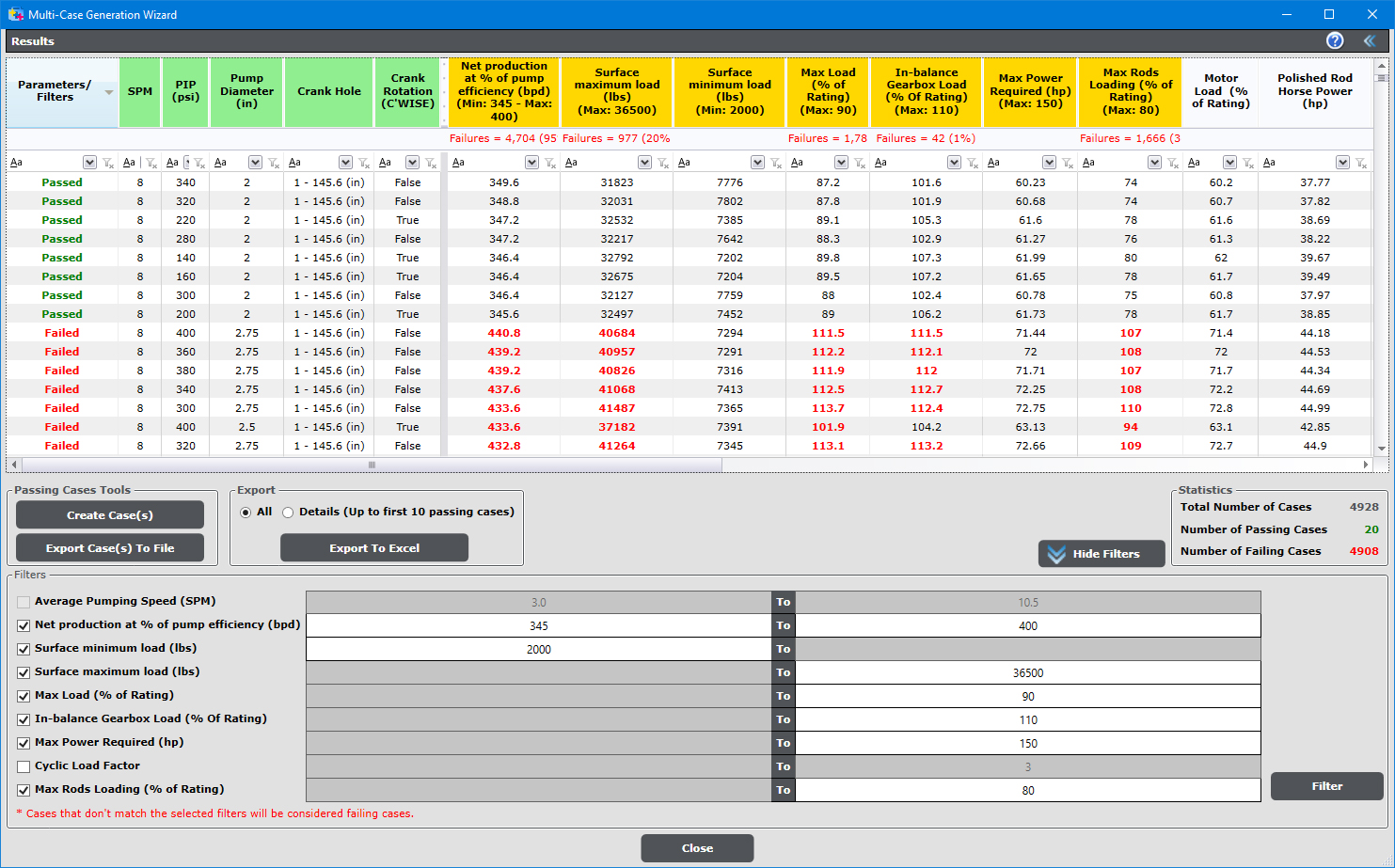
For example, ranges may be provided for production targets, pumping speeds, pump diameters, pump depths, fluid levels and more—quickly creating tens, if not several hundred design cases automatically. Results may be compared in a table format with operator-defined thresholds for pass/fail requirements. Design scenarios failing to meet such requirements are automatically filtered out and identified. A power filter function assists the operator to quickly identify the most efficient case from the passing cases.
Consider a well producing 100 bopd today that may decline to 10 bopd in the future. The engineer needs to know whether the current design will still work as the well declines. That person may also need to understand what happens if the pump is lowered at a later date, if speed changes, if stroke length changes or if a different pump size is selected. With multi-case modeling, those same questions can be tested automatically as a range of scenarios.
In one demonstration of this type of workflow, an engineer modeled different combinations of speed, pump size and stroke length, generating more than 260 cases in seconds with the Multi-Case Generation Wizard in LUFKIN SROD™ Ver. 9.5.0. Some scenarios passed; others failed, because the equipment was overloaded or operating outside acceptable limits. From there, the engineer could filter the passing cases, adjust the parameters and continue narrowing the design until the selected equipment matched the expected operating window, Fig. 1.
FASTER DESIGN WORKFLOWS SUPPORT BETTER PRODUCTION ECONOMICS
SROD 9.5.0 demonstrates how this workflow is evolving. The ability to import multiple existing rod lift design files from other platforms and combining those into a single well file simultaneously provides operators with the ability to efficiently evaluate multiple legacy well designs in a single table format without having to manually re-enter all well data and starting from scratch. Combining wave equation modeling with the Multi-Case Generation Wizard enables engineers to test hundreds of simulations in seconds to quickly identify the most efficient, reliable pumping solution.
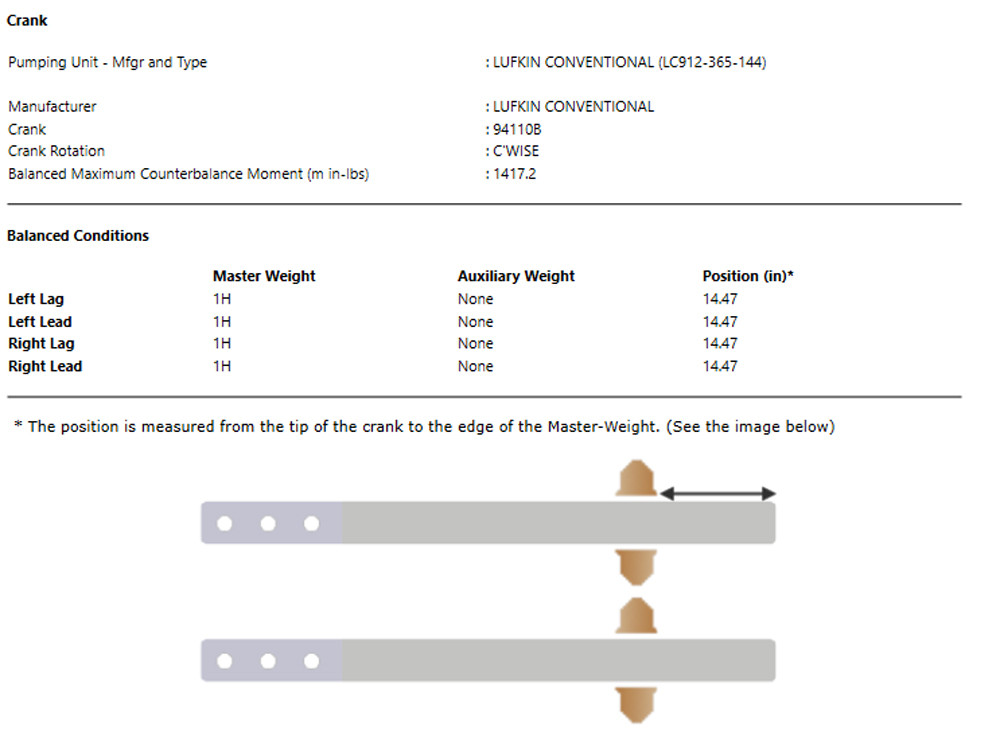
The platform also adds balancing and counterbalance reporting capabilities designed to help engineers determine efficient counterweight configurations to right-size equipment for the operating range of the well. That matters, because rod lift optimization is not limited to downhole design. Surface equipment, motor sizing and counterbalancing all influence how efficiently the system runs and how much stress it places on the equipment, Fig. 2.
The broader trend is clear across the industry. As assets age and production teams look for incremental gains, digital tools are becoming more important for operational efficiency. Deloitte's 2026 oil and gas outlook notes that as shale productivity gains flatten and assets age, digitally enabled operations are becoming a more important lever for competitiveness.
For rod lift, that digital shift does not replace engineering judgment. It provides engineers with more information in less time. A veteran engineer may still understand the field history better than any software can. However, when that knowledge is combined with faster scenario modeling, clearer comparisons and more efficient design import functions, teams can make decisions with greater confidence and speed.
The bottom-line impact comes from making improved design iteration practical. When engineers can quickly test how a well performs across different speeds, pump sizes, stroke lengths, production rates and future operating conditions, they can identify designs that balance production, efficiency and equipment longevity. That will help operators reduce avoidable failures, control power consumption, extend run times and in the process optimize available engineering resources.

Regardless of a well’s age, those improvements matter. Whether the wells are mature or new, or high-or-low-volume producers, all of them require disciplined engineering. As rod lift design platforms continue to evolve, operators that can evaluate more scenarios with greater speed, preserve legacy design data, and translate engineering insights faster into design decisions will be well-positioned to keep production flowing longer—and do so cost-effectively.
PETER WESTERKAMP is vice president of Automation – Global Sales at Lufkin Industries. With a career spanning global engineering, sales, and product innovation, he has led numerous R&D initiatives and is a frequent speaker and contributor to organizations, such as SPE and ALRDC.
- Subsea technology- Corrosion monitoring: From failure to success (February 2024)
- Applying ultra-deep LWD resistivity technology successfully in a SAGD operation (May 2019)
- Adoption of wireless intelligent completions advances (May 2019)
- Majors double down as takeaway crunch eases (April 2019)
- What’s new in well logging and formation evaluation (April 2019)
- Qualification of a 20,000-psi subsea BOP: A collaborative approach (February 2019)