Offshore, onshore panels bring encouraging views to Energy Workforce attendees
Kurt Abraham, Editor-in-Chief, World Oil
Despite the situation in the Middle East, the global upstream industry, particularly in the U.S., continues to crank out greater efficiencies and productivity across the globe. That was the message delivered to attendees during two panels at the annual meeting of the Energy Workforce & Technology Council in Tucson, Arizona. The Offshore and Onshore panelists were composed of a variety of operators, plus one drilling contractor and one asset management company.
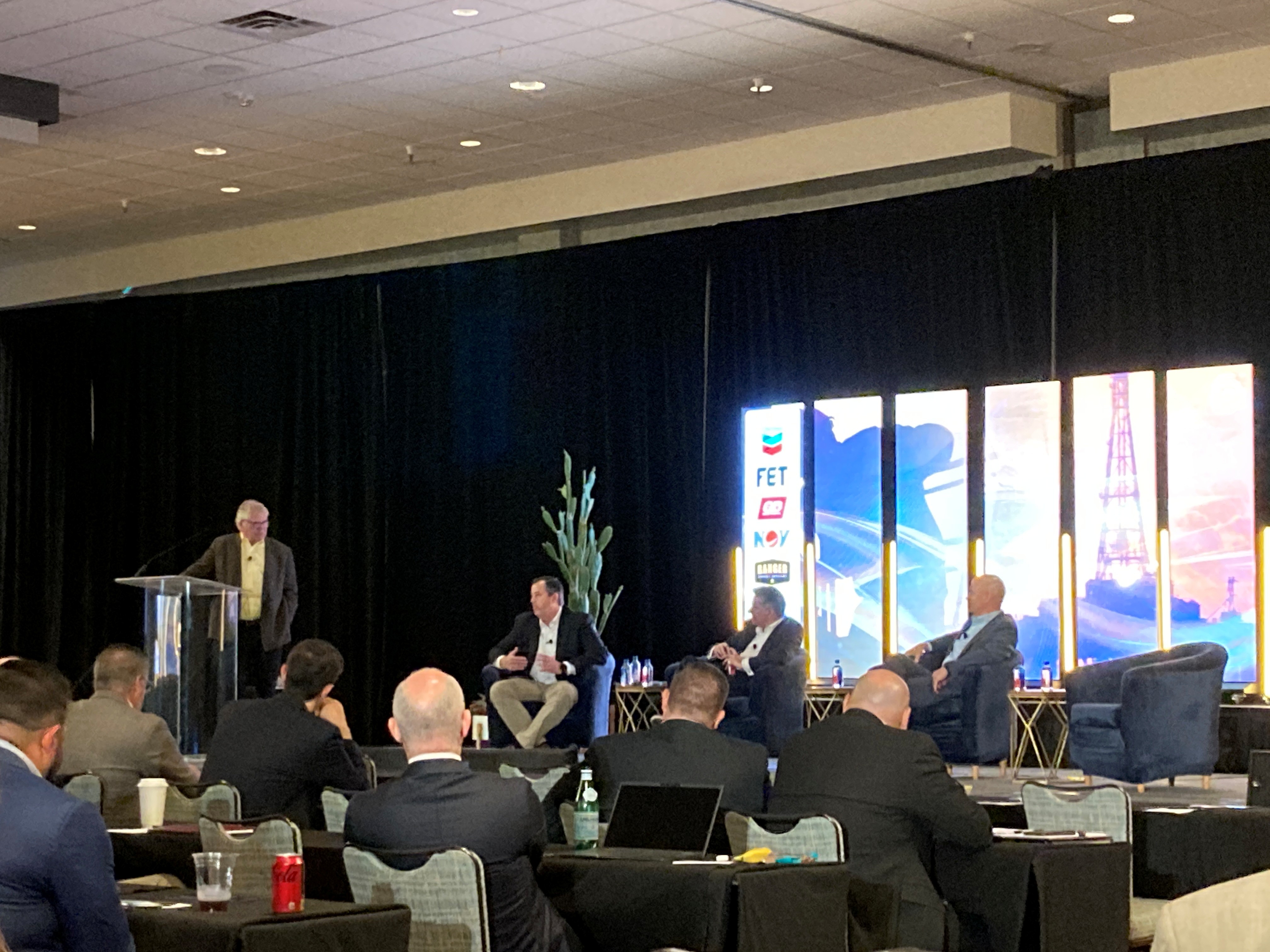
Offshore panel. First up yesterday were the offshore panelists, Fig. 1. They included Blake Denton, Senior V.P. for Marketing & Contracts at Noble Corporation; Siva Gollakota, V.P. of Supply Chain at Talos Energy; and John Seeger, CEO, Commodore Offshore Operating, LLC. The moderator was Jim Wicklund, Managing Director for Business Development and Corporate Communications at investment banking firm PPHB.
Wicklund got the panel going by making the observation that for much of the last 10 years, the offshore, and deepwater in particular, have been “in the wilderness.” However, he was quick to point out that “in the last 2 ½ years, there’s been a resurgence” in offshore work, very much spurred by the deepwater portion.
Gollakota was quick to agree. “Yes, the deepwater [sector] is looking much better,” he stated. “Our (Talos’) focus has been on the scale and profitability of deepwater [activity]. It’s quite attractive.” Noble’s Denton was also optimistic about an increase in offshore work, including deepwater projects. “We’re pretty encouraged by the long-term outlook for the offshore [sector]. Offshore is going to play a great role, both short- and long-term.”
While his peers advocated for deepwater activity, Commodore’s Seeger spoke up for shallow-water projects, particularly in the Gulf of America/Mexico where his company has its focus. Acknowledging that shallow-water projects are actually more challenging in some ways at present, Seeger said that such work is “still a very attractive investment.” In support of that contention, as well as an overall boost in offshore activity in the Gulf, Seeger reminded attendees, “If you think about U.S. oil production, probably 7 MMbpd to 9 MMbpd is unconventional, but it may be hitting a plateau. Can its growth continue over the next five years? Probably not. Looking at demand forecasts, we think that the Gulf is going to fill the gap between unconventional output and demand. I’m not going to say that there will be a big jump in offshore rig count, but it will tick up some.”
Switching gears, Wicklund asked the panelists which technologies are helping them in their offshore operations. Gollakota offered that his firm is “using A.I. more in our operations. We’re a big believer in the difference that A.I. can make. Our next focus is on how A.I. can improve the effectiveness of our production.”
From the drilling contractor viewpoint, Denton said that on rig technology, “now what we see more than anything else is the push to automate. The value we can deliver in the well construction process is how we can reduce the number of drilling day, rather than reduce dayrates. Denton also pointed out that the industry increasingly is using performance-based contracts. “And so, you are making offshore-based energy more cost competitive.”
Seeger remarked that his firm, too, recognizes the role of such contracts. “We have used performance-based contracts with drillers,” said Seeger. “Some have worked, and some have not. They can be more difficult to use.” Gollakota confirmed that Talos is part of the trend. “We are using some performance-based contracts,” he said. “We’re trending toward more of them, but they can be difficult to administer.”
As regards the “hot spots” for offshore activity, Noble’s Denton listed West Africa, Brazil, Guyana and Suriname as obvious choices. “Another place not mentioned is Indonesia,” elaborated Denton. And we’ll see what India may do. The North Sea has really been driven by policy. So, that’s been a [major] distraction. If they (UK officials) unwind the profit levy, then maybe activity might increase.”
On a final subject, Wicklund asked the panelists how much the industry’s people situation is affecting their operations. “We can’t get a good hydraulic workover unit that has good, qualified hands,” complained Seeger. “It’s a critical risk, trying to get and retain good people.” Gollakota said that Talos has fared better. “We are blessed to have a good volume of people.” However, he added, “the composition of the work and ability of people to do it is shifting.”
Noble’s Denton said that “as far as crewing rigs, the U.S. is getting harder than international. The available pool keeps getting smaller. What you see is there’s a consistent composition of ex-pats in managerial positions [overseas].” He explained further that his company works with governments in other countries to bring in local people to some positions.
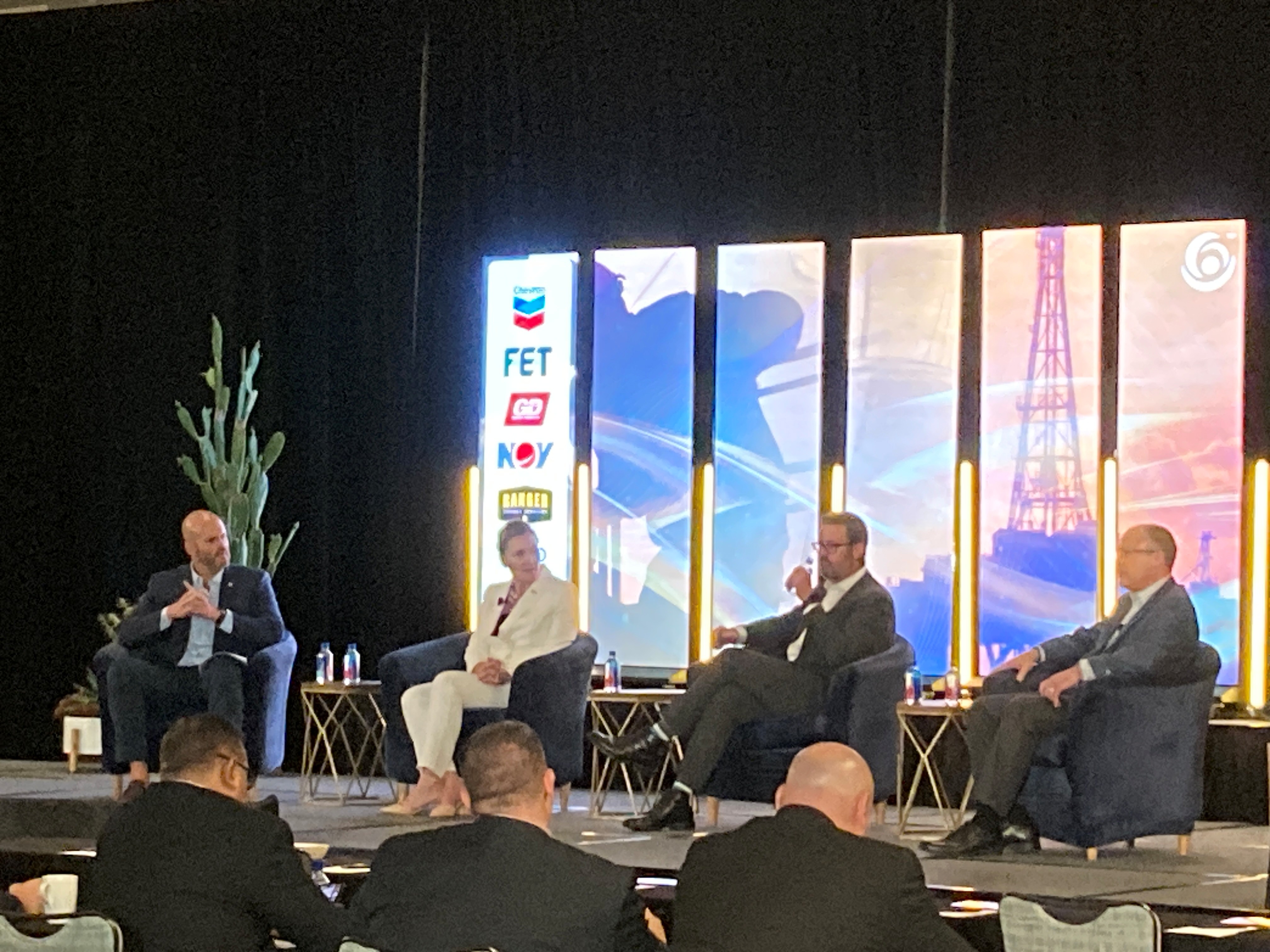
Onshore panel. Later on Wednesday morning, the Onshore Operators Panel (Fig. 2) featured three U.S. operators, including Sarah Fenton, Executive V. P., Upstream at EQT; Jamie Bernard, President of SOGC, LLC (formerly known as Sinclair Oil & Gas Company); and Chad McAllaster, Executive V.P., Operations, Diamondback Energy. The moderator was Sam Sledge, Director & CEO, ProPetro.
One of the things that Sledge had panelists dive into early was the issue of safety of operations, since it is a signature item that the Council addresses frequently as a cornerstone issue. Interestingly, all three panelists agreed that the number-one safety issue is not wellsite operations but rather driving—as in driving trucks between service/supply bases and wellsites/fields. “The most dangerous thing at EQT is not drilling, fracing, etc.,” said Fenton. “It’s driving. (But at field sites,) we’ll actually encourage folks—and celebrate them—to stop work (and avoid an incident).
As for how the geopolitical environment elsewhere on the globe might be affecting their level of activity in the U.S., the panelists had differing views on how to react. “We have very distinct metrics,” observed SOGC’s Bernard. “We’re nimble, we’re small. We can pivot quickly. The challenge is that we don’t have a one-year rig program, but we can get rigs fairly easily, if we need them.
Diamondback’s McAllaster said his company is less likely to react quickly. “We’re a large-scale driller. We drill about 350 to 400 wells per year,” he noted. “We’ve got a process on how to react, if at all. It starts with an internal debate on what the possibilities might be and what would need to be implemented.”
Fenton answered the question by explaining her firm’s operating philosophy. “We practice combo-development,” she said. This is an operational strategy focuses on developing multiple large-scale, multi-well pads simultaneously, rather than in isolation. This process is designed to reduce costs by up to 30%. Indeed, “we focus on low-cost operations,” elaborated Fenton. “Our gas breakeven is $2 per MMBtu.
One of Sledge’s more provocative questions was “If there’s very little left to squeeze on efficiencies, does the technology still get better?” The response from all three panelists as an emphatic “yes.” McAllaster said there is still more than can be done in all categories, from drilling to completions to production. “What excites me is what we can do on the production side,” he said. “I’m talking about plunger lift, ESPs, automation, and the role of A.I. in all of it.”