CERAWeek Day 2: Alberta’s Danielle Smith emphasizes province’s potential
(WO) - The high-level conversations continued on Tuesday morning at CERAWeek by S&P Global 2026, with Canada being one of the focal points. Leading the charge to advocate for Canadian oil and gas was Alberta’s provincial premier, Danielle Smith, who appeared in a conversational session entitled, “Alberta and Energy Security: From North America to the World—A Policy Dialogue.”
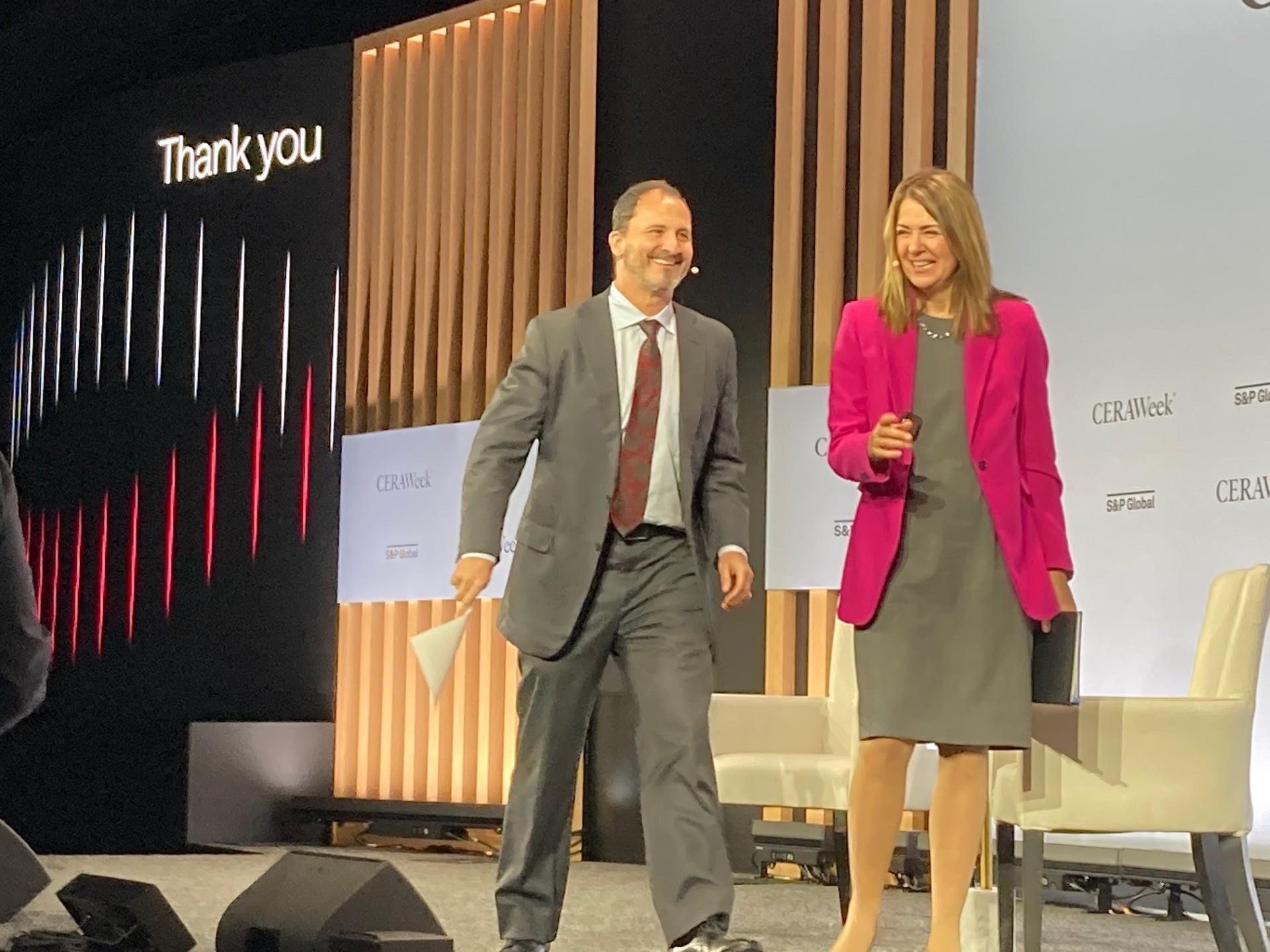
Global energy security. Serving as moderator was Raoul LeBlanc, Vice President for Upstream at S&P Global. He wasted no time delving into the topic of energy security from Alberta’s perspective. He asked Premier Smith about the role that Alberta “plays in the energy world right now.”
Smith pointed out that the province did a media campaign last year that stated “Alberta is the answer.” And, she added, “I would say [that] we brought, more broadly, [that] Canada is the answer to a lot of the issues that have been identified by the U.S., especially when you expand on talking about critical minerals.”
“But when you look at the Alberta story, last year, while we were here, we unveiled our new reserve study. And we've updated it again. We've got 177 Bbbl of recoverable oil reserves at today's prices, and 144 Tcf that are recoverable at today’s technology, plus 5 Bbbl to 10 Bbbl of natural gas liquids.
Smith mentioned that Alberta also has considerable solar and wind that are on its grid, 38% installed, 23% that is being used to generate power. She said that provincial officials are working with the federal government to create a nuclear structure, in addition to geothermal [potential]. Plus, she added, Alberta has “a whole array of critical minerals,” including lithium.
“So, when we put that value proposition on the table, it's just when can we get started in getting more of this moved to market. And so, one of the conversations that we've been having here, is yes, you probably heard we want to build a million barrels-a-day pipeline to the west coast, but there are also proponents, who would like to build about 2.5 MMbpd of additional egress to the United States, which I think has a whole chain of support on oil that would assist with some of the current problems we're facing. We can also be the backstop on natural gas…”
Alberta’s energy security. Taking the conversation to a more local level, LeBlanc asked the Premier what she thinks are the pillars that are most important for Alberta’s energy security.
“Well, clearly, oil drives so much,” responded Smith. “When you look at the prices that we have today, what does [adding another 15 MMbopd] do for our economy? That's a $31 billion addition to GDP, which would be about 1% of our GDP, which is pretty big for a country of our size…As a province, much as we want to build east and west, It's not a poor value proposition for us to also export to the U.S. Because we think we can access international markets that way, as well.
Asked by LeBlance for more elaboration, Smith replied, “At the World Petroleum Congress in 2023, I said we wanted to double our oil and gas production. So, when I said that, we were at about 3.7 MMbpd. I think we're up close to 5 MMbpd, so I want to get to 8 MMbpd. If you build [pipeline capacity of] 1.5 MM new barrels to the west coast, and 1.5 MM new barrels south, then we're in a position where we can be among [the very top producers]., We're already the fourth-largest producer and the fourth-largest reserve in the world. We can just solidify that role.
The Middle Eastern effect on North America. Given the situation in the Middle East, LeBlance asked Smith whether politicians and industry people are coming up to her and asking about opportunities to do capital projects in North America, specifically Canada.
“Well, the only regret I have is that we didn't do this 10 years ago, because if we had, if we had proceeded with the Keystone XL pipeline and the Energy East pipeline and the Northern Gateway pipeline, then we would already have 2.5 MMbbl of additional egress onto the market. And so, the next best time is to start now. We've also learned a few things as well. I think that partnering with an American pipeline company to understand some of the local nuances and be able to assist with the permitting is something that South Bow has realized. South Bow has a lot of the old Keystone assets, and they've partnered with Bridger on a new [effort], which I think they want to start at 450,000 bbl but could perhaps even double that. The other part is most of this approval has to happen on the American side of the border.
More exclusive CERAWeek coverage: ConocoPhillips CEO warns supply losses, infrastructure gaps will drive higher oil prices
Improvements in taxes. Questioned by LeBlanc about some regulatory changes within Canada, the Premier said that a number of positive things have finally occurred. “What happened in Canada was a recalibration that the entire world did after the Russian invasion of Ukraine,” stated Smith. “Now, with the instability in the Middle East, I think that's the second recalibration. When life gets too expensive for regular people, politicians hear about it and layering on carbon taxes at the retail level, industrial carbon taxes, energy restrictions and reducing the supply is causing the price of everything to go up. And so, when that happens, the public says enough. And so, fortunately, the federal government heard that call, and it has repealed some of those retail carbon taxes, and are addressing some of the things that have been driving the cost of energy.
These successes prompted LeBlanc to ask Smith how officials can “future-proof’ these changes, so that a new administration coming in could not change everything. “Isn't that the challenge,” said the Premier rhetorically. “I would tell you that I don't know that our politics are quite as polarized as what we see in the United States. It seems like it's going to be very difficult to get bipartisan agreement. And I think what you should take heart in, in looking at the Canadian context, is in the provinces, we have socialist governments, they're called the New Democrats. We have liberal governments. We have the conservative governments. Then, of course, we've got the federal government. And it doesn't matter what ideological path each of those premiers or the federal government is wearing. We're all saying, how do we get to ‘yes.’ And that's why you're seeing major pipeline projects being proposed, major transmission lines being proposed, LNG projects, and mining projects.
Alberta’s future. LeBlanc finished up by asking the Premier what the vision of the future is for Alberta. “Well, I would say that in Alberta, as I mentioned, we want to double our oil and gas production. So that means going to 8.0 MMbpd, hopefully by 2035. We have 11 Bcfd of gas, and that means [going to] 22 Bcfd of gas. So, how do we double all those? I think that what I would like to see is that not only do we come to an agreement with the federal government on building this line to the northwest BC coast, but also expanding [the] Trans Mountain [line].
Smith finished off the session with a comment about Alberta’s relationship with the U.S. “We just want to be helpful, we don't want to pick any fights.”