Crimped centralizer solution enables record length casing runs in ERD wells
As drilling technology advances, Extended Reach Drilling (ERD) wells have become more common. Shale operators seek to boost reservoir production and reduce surface impact, all while lowering overall well construction costs and maintaining a relentless focus on time savings. High-performance rigs and optimization practices have combined to enable these longer laterals. Mergers and acquisitions increase contiguous acreage, allowing wells to better exploit formation structure and increase available production. Innovations like rotary steerable systems, improved drill bits, and reliable BHA technology have all contributed to year-over-year lateral length increases.
Casing running operations in longer Extended Reach Drilling (ERD) horizontal wells can command more rig time and add operational complexity at a critical moment in the well construction process, particularly in wells longer than three miles. Volant’s crimped HydroFORM™ centralizer solution is an enabling reach extension technology that improves casing running efficiency and effectiveness and is proven in some of the longest wells drilled in North America to date. When used in conjunction with flotation and rotation, and active management of casing connection integrity, the solution reduces flat time and enables successful casing runs to total depth (TD).
CASING RUNNING IN EXTENDED REACH WELLS
In horizontal well deployments with shorter horizontal sections and smaller reach-to-depth ratios, mud-filled casing or liner can generally be installed by sliding into the hole, and circulation can be used to clean the hole if needed. For longer wells, where running friction becomes limiting with this basic approach, flotation techniques are often used. In these cases, casing is air-filled during running to increase buoyancy, diminishing contact loads with the borehole and reducing running friction. A highly effective variation of this strategy involves the use of a flotation "sub" at the top end of the floated length of pipe, allowing mud-filled casing to impart more weight on the lower part of the casing system and assisting in sliding to TD.
ROTATION AND HOOKLOAD RECOVERY
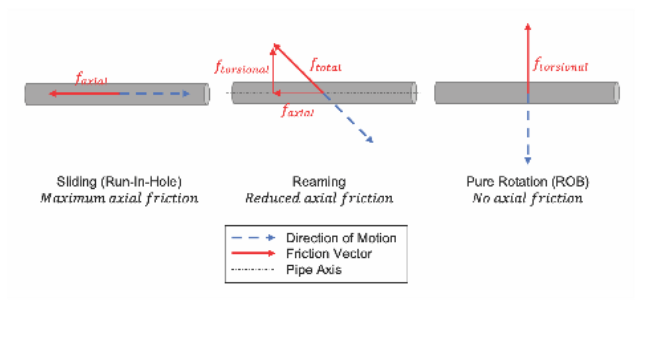
When reach limits of these commonly used sliding methods are encountered, rotation can be used as another effective mechanism for reducing axial friction. When a casing string is rotated as it is run in hole using a top-drive Casing Running Tool (CRT), friction at downhole contact points acts in the opposite direction to motion at the borehole interface, as shown in (Fig. 1). This means that rotation reduces sliding resistance into the hole, increasing available hookload. This also creates rotational drag that must be overcome by applying torque to the string at surface. Rotation can be employed in conjunction with flotation, in which case better hole conditioning prior to the casing run can aid overall execution. The practice of rotating air-filled casing, known as "dry reaming," is becoming more widely adopted in extreme ERD wells in attempts to further reduce drag and maintain hookload to TD.
More operators are turning to rotation as a reach extension mechanism. Downhole strings are being configured to handle the torque and combined loads that are experienced using this method. Major pipe and connection providers continue to develop high-torque connections for unconventional wells, with available connection operating torque limits exceeding 40,000 ft-lbs on typical 5.5″ shale production casing strings. Lower-torque connection solutions may also be viable if rig crews are actively informed of safe surface loading limits. This is most effective if connection suppliers provide combined torsional loading limits that can be used with a real-time driller advisory system such as VolantRED™, Volant’s cloud-based platform for planning, monitoring, and optimizing casing running operations.
CENTRALIZERS
Casing centralizers of varying designs and compositions are used primarily to create standoff between the borehole and tubular body, promoting cement coverage to improve hydraulic isolation between frac stages. These accessories are usually installed at the rig site and are often slid on by hand on the rig floor in the red zone during the make-up procedure. Centralizers are most commonly installed in a “floating” configuration, whereby they are free to rotate on the pipe body and to translate between stop collars or pipe couplings. Although low-friction floating centralizers can be effective at reducing running drag during sliding, they can have a limiting effect on running efficiency and effectiveness once rotation is initiated, particularly when slippage occurs at the pipe/centralizer interface.
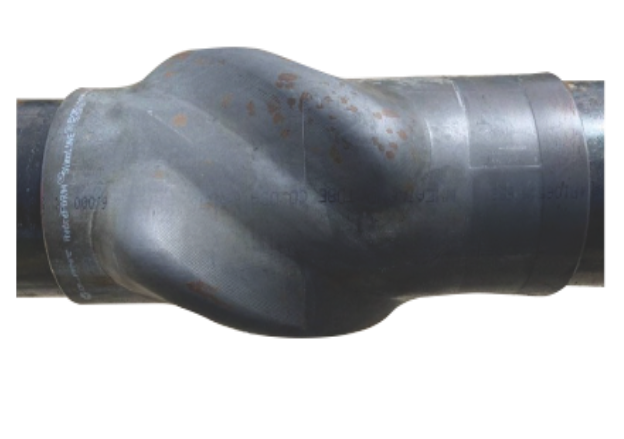
For casing running operations in ERD wells, the use of solid body HydroFORM™ casing centralizers crimped to the casing (Fig. 2) has been proven as a simple and effective solution for overcoming friction and extending lateral reach while preserving standoff and hydraulic isolation. This solution was originally developed to support casing while drilling (CwD) applications and has now become commonly deployed in running applications.
CASE STUDY
An operator in the Marcellus shale was seeking technologies to improve casing running in an ERD application where running challenges had been encountered, and where the desire was to continue to increase lateral lengths in future wells. In a series of wells, diminishing hookload had led the operator to initially reciprocate and then to rotate the string before a flotation sub was installed.
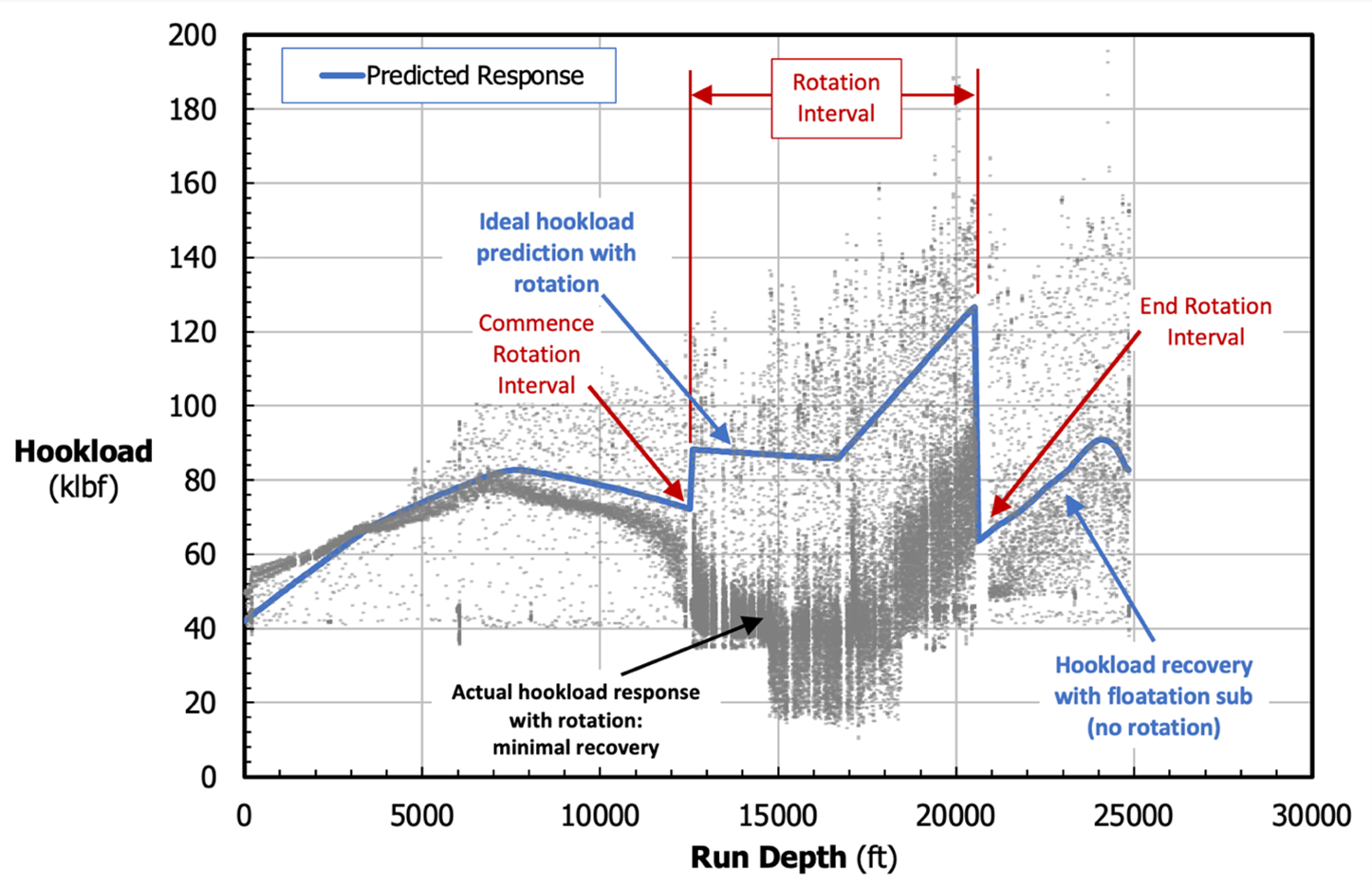
Rotation did not lead to recovery of hookload, and ongoing reciprocation was required, reducing running efficiency in the lateral section. In the example well (Fig. 3), the casing run slowed significantly during rotation over a 7,900 ft interval, even though rotation was originally expected to provide greater efficiency than reciprocation.
The earlier running data was compared to torque-and-drag (T&D) predictions, and it became apparent that the T&D model was not accurately estimating hookload during rotation. It was suspected that the free-rotating casing centralizers were slipping relative to the pipe body, limiting rotation effectiveness. Given the increased lateral length targets of future wells, the operator indicated interest in the benefits of field-tested fixed centralizers that rotate with the pipe.
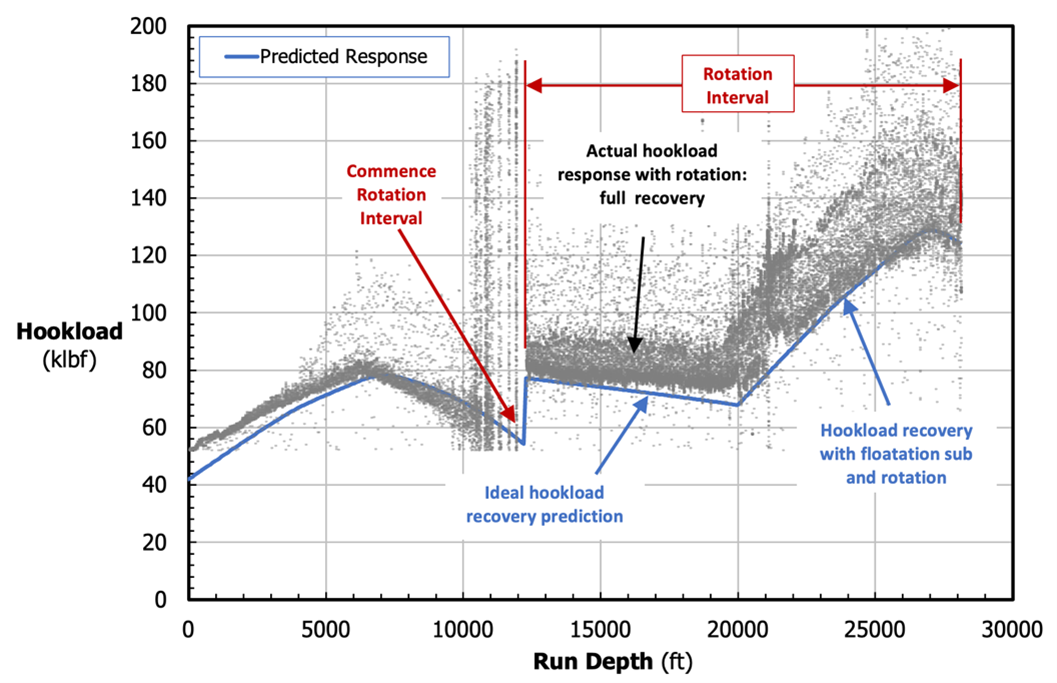
Volant's casing running optimization team utilized its VolantRED™ casing running planning, monitoring, and optimization platform to benchmark data from several prior casing runs to torque and drag analysis results, establishing the observed range of friction factors and assessing the effect of floating centralizers on downhole friction. This data was then used to model a longer future planned well and predict the impact of crimped centralizers on running performance and surface torque demand. The predicted and measured hookload response using this casing running strategy are shown in (Fig. 4). In this case, significant hookload recovery was observed at the point that rotation commenced, and the field data closely aligns with torque and drag predictions. Peak torque demand matched expectations at approximately 21,500 ft-lb with the string at total depth.
OBSTRUCTION CAPACITY
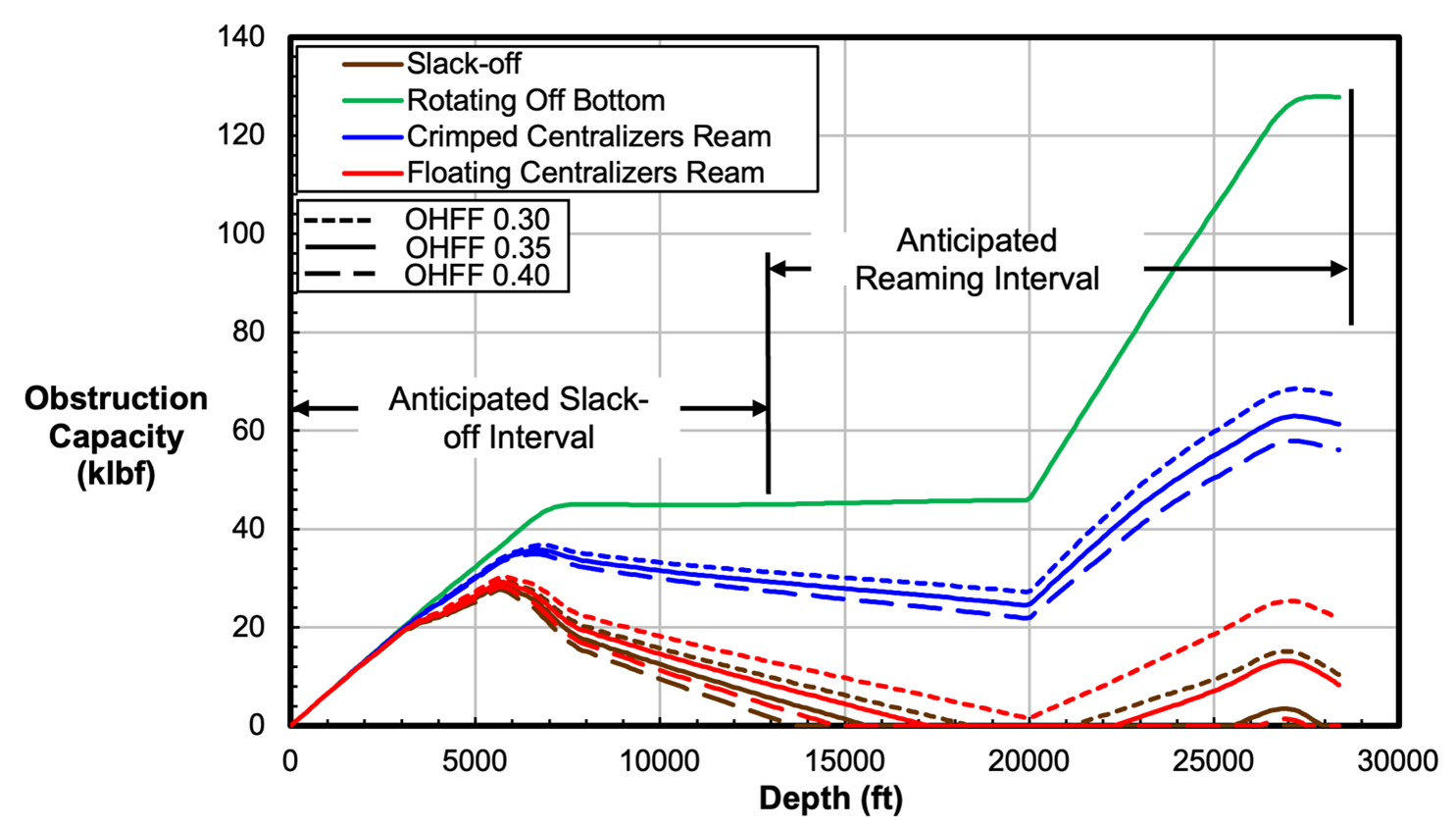
The effectiveness of the crimped centralizer solution for running operations is highlighted using another simple running metric that complements the hookload chart, defined here as the obstruction capacity. The obstruction capacity represents the highest downhole axial load that could be applied to an obstruction at the end of the casing string if the surface hookload were completely slacked off and can be thought of as equivalent to the maximum available weight on bit. (Fig. 5) compares the obstruction capacity of the floating and fixed centralizer solutions as a function of run depth and shows that when the string with fixed centralizers is rotated, a substantial change is available in downhole force to propel the string forward. Utilizing VolantRED™, Volant includes obstruction capacity estimates in all pre- and post-run customer running optimization assessments and generally finds good alignment between this metric and the onset of running challenges.
CENTRALIZER INSTALLATION
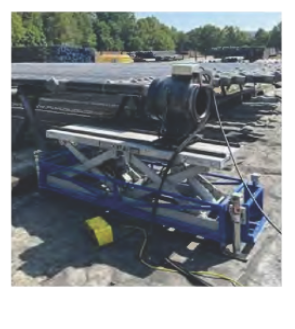
Centralizer installation preferably takes place at the customer's yard and involves crimping Volant HydroFORM™ centralizers to the casing to create radial interference, fixing each centralizer in place. Operations are optimized with a reliable computer-aided crimping system (Fig. 6), resulting in an installation rate of over 300 centralizers per day. This decrease in installation time has coincided with improved recording and reporting methods and has enabled the economic and minimal additional planning burden to align with historically tight shale drilling budgets. This method takes the installation of centralizers away from the critical path and reduces personnel exposure and install time on location.
ONGOING OPERATIONS
Casing strings combined with flotation subs and crimped HydroFORM™ centralizers have been successfully landed to target depths of over 32,000 ft, in wells with lateral lengths of more than 4.8 miles, using Volant (CRTe-1.0 & 2.0 GM5.50) external grip casing running tools on every subsequent well for the operator featured in the case study. Rotation for many of the horizontal sections results in efficient progress with sustained hookload. In the vast majority of runs, operators begin rotating early enough in the run to avoid any reciprocation prior to flotation sub installation and sustain this running mode for the remainder of the horizontal section.
The inclusion of the crimped centralizer method as an integral component in the casing running strategy has resulted in several U.S. land lateral length records being set. This method has also been adopted by other operators in multiple shale applications. Strings are typically configured with one centralizer per joint for the entire lateral and build section. This centralization configuration balances standoff requirements with the positive effect that the crimp centralizers have on overall running drag.
EFFICIENCY BENEFITS
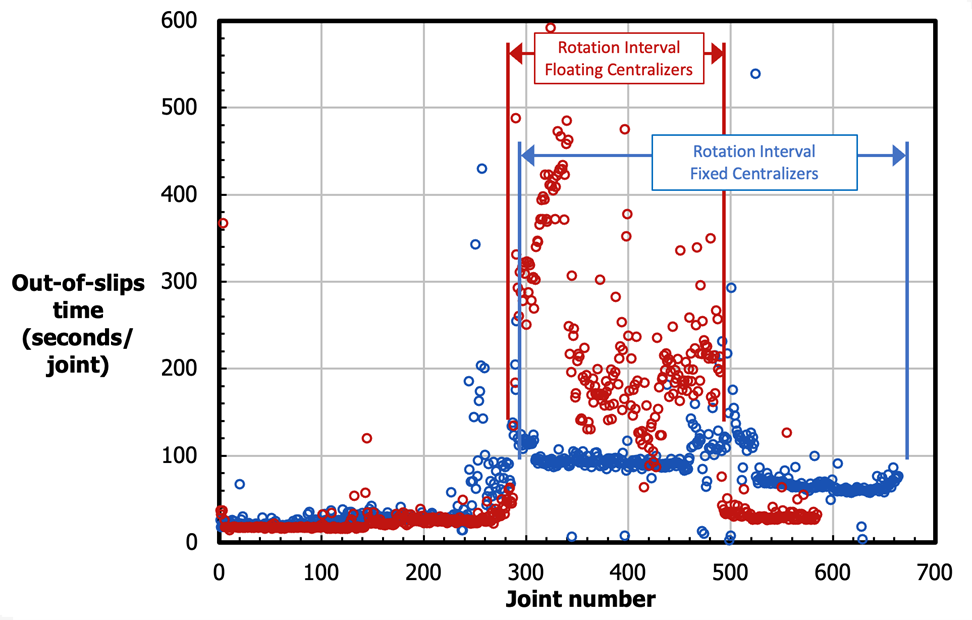
One other advantage that has been seen is more consistent slip-to-slip times per joint during the rotation interval. This predictability can be used to forecast running times and maximize weight on bit right up to TD, further optimizing casing running operations. (Fig. 7) shows the in- and out-of-slips times for the crimped centralizer run introduced earlier. When comparing the out-of-slip running times between the floating and crimped runs in the rotation interval, a vast reduction in running times and an obvious increase in consistency are seen with the crimped solution.
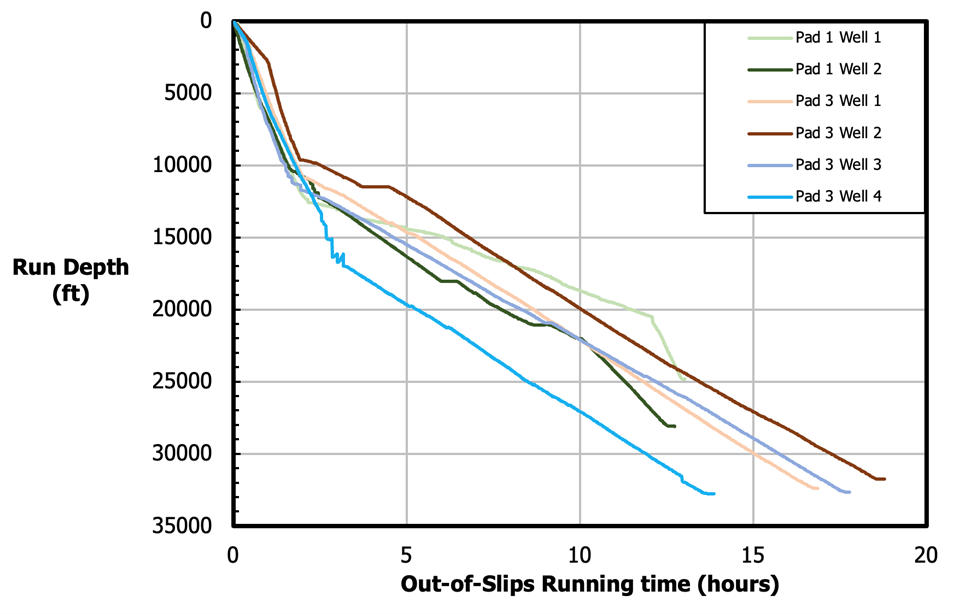
Adopters have commented on the security that installation has created in the planning and execution phase of their casing running operation, and this is reflected in the consistency of out-of-slips running times for sample wells (Fig. 8). One drilling and completions manager stated that the use of the solid body crimp-on centralizers has “allowed them to push lateral lengths from 20,000 to 25,000 feet.”
SUMMARY
Combining Volant's technology and expertise with a field-proven crimped centralizer solution provides a cost-effective and reliable method for improving reliability in casing running operations, particularly in extreme-reach ERD wells. By using an efficient, computer-aided crimping process to securely fix centralizers to the casing, operators can deploy surface rotation to minimize running friction and increase the capacity to overcome downhole obstructions. Higher torque connections are utilized alongside Volant's cloud-based platform for planning, monitoring, and optimizing casing running operations. This system has demonstrated significant success in the Marcellus shale, with adopters attributing the extension of well reach from 20,000 ft to 25,000 ft directly to its implementation.
ABOUT THE AUTHOR

DAN DALL'ACQUA is VP, Engineering Solutions at Volant Products and Principal Consultant at Noetic Engineering. His 30-year mechanical engineering career has included deep focus working with operators on the development and implementation of tubular and connection system design and evaluation bases for extreme service wells.
Dan's interest in extended-reach drilling (ERD) wells relates to optimizing the effectiveness and efficiency of downhole casing running operations, including harnessing hardware solutions and digital technologies to enable drilling teams to build better wells. As a subject matter expert on casing system integrity, he has presented and authored SPE papers on topics ranging from thermal tubular system design to ERD running optimization, and currently co-chairs the SPE Well Integrity Technical Section’s Casing Deformation Work Group.