Issue: March
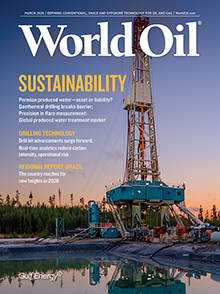
COLUMNS
While geopolitical turmoil and shale headwinds dominate headlines, deepwater is quietly surging. In this month’s column, editor-in-chief Kurt Abraham recaps World Oil’s Deepwater Development Conference, where operators and contractors pointed to rising activity, stronger production growth and a robust project pipeline.
FEATURES
As inspection demands rise, and skilled labor becomes harder to source, oil and gas operators are rethinking how hazardous facilities are monitored. Ex certified autonomous inspection robots are emerging as a practical tool to improve safety, emissions control and asset reliability across onshore and offshore operations.
From record-shattering pre-salt output and a landmark OPEC+ debut, to a $109 billion investment mandate and the contradictions of hosting COP30, Brazil’s hydrocarbons sector has entered one its most consequential chapters. This report examines the defining decisions of the past 12 months, and charts the terrain for the year ahead.
To deal with challenging formations while boosting efficiencies and keeping costs down, equipment manufacturers have introduced a host of new bits and technologies. The innovations even extend into geothermal drilling. This round-up of bit innovations examines the individual products and their features.
SPECIAL FOCUS: SUSTAINABILITY
Superhot rock geothermal is one of the most promising frontiers in the global energy transition, with the potential to produce significantly more power per well and allow geothermal energy to scale to new heights, Today, the 200°C temperature barrier in directional drilling has finally been broken, an engineering challenge that the industry has pursued for more than 25 years.
As issues such as water scarcity, environmental regulations, and corporate sustainability mandates come to the forefront, produced water treatment has become a strategic imperative for industries far beyond oil and gas. It is one of the fastest-growing segments in the water treatment industry, which has emerged as an amalgamation of environmental stewardship, regulatory compliance and technological innovation.
Over the next 10 years, it is expected that beneficial reuse will outpace recycling. With the emergence of data centers and drought conditions in West Texas, the demand for new water will be increasing, and treated produced water will be there to fill that demand.
A quantified, field-proven framework for lower-carbon, safer, and more predictable well construction.
This article explores tightening of methane and flaring regulations and the need for precise measurement. It explains why CO₂ challenges ultrasonic sensing and how Fluenta’s FlarePhase technology enables accurate flare gas measurement, even under extreme, high CO₂ conditions.
MANAGEMENT ISSUES
In our independent industry every day, the bonds among local oil and gas producers—and our shared commitment to the places we call home—remain our greatest asset.